Animals / Bird
Yellow-rumped warbler
Setophaga coronata · Parulidae
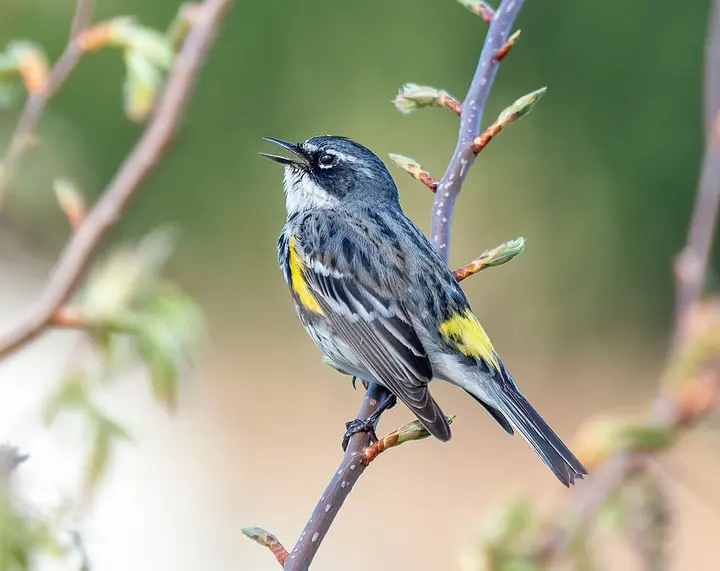
The yellow-rumped warbler is a North American bird species that can be commonly observed all across the continent. Its extensive range connects both the Pacific and Atlantic coasts of the U.S. as well as Canada and Central America, with the population concentrated in the continent's northern reaches during the breeding season and migrating southwards to southern North and Central America in the winter. It generally prefers coniferous forests or mixed coniferous-deciduous forests as its breeding habitat, while during the winter it can be found inhabiting more open areas such as shrublands that offer food resources.
The yellow-rumped warbler is primarily insectivorous, though the species eats fruit such as juniper berries, especially in winter. The species combines four closely related forms: the eastern myrtle warbler (spp. coronata); its western counterpart, Audubon's warbler (spp. group auduboni); the northwest Mexican black-fronted warbler (spp. nigrifrons); and the Guatemalan Goldman's warbler (spp. goldmani). All subspecies of the yellow-rumped warbler are characterized by the yellow rump as its name implies, while intra-group and inter-group variations in appearance exist in spite of many similarities. The myrtle and Audubon's groups, as two major subspecies, are distinguished by noticeable features such as differing throat colorations.
Appearance
The yellow-rumped warbler has an average length of 14 cm and weight of 12.5 g, its appearance is different across its subspecies groups, especially the two major ones: the coronata group (myrtle warbler) and the auduboni group (Audubon's warbler); intra-group variations are also observed. In spite of varying appearances, the yellow rump (as suggested by its name) is present in all subspecies and thus characterizes the yellow-rumped warbler.
Behaviour
Audubon's and myrtle warblers are among North America's most abundant neotropical migrants. While they are primarily insectivorous, the species is perhaps the most versatile foragers of all warblers. Beyond gleaning from leaves like other New World warblers, they often flit, flycatcher-like, out from their perches in short loops, to catch flying insects.
Habitat
The yellow-rumped warbler breeds from eastern North America west to the Pacific, and southward from there into Western Mexico. Goldman's yellow-rumped warbler is a non-migratory endemic within the highlands of Guatemala, and the black-fronted warbler is a non-migratory Mexican endemic. The myrtle and Audubon's forms are migratory, wintering in the southern U.S., Mexico, Central America, and the Caribbean.
Life cycle
Audubon's and the myrtle nest in coniferous and mixed woodlands, and lay 4–5 eggs. Females build the nest, sometimes using material the male carries to her. The nest is a cup of twigs, pine needles, grasses, and rootlets. She may also use moose, horse, and deer hair, moss, and lichens. She lines this cup with fine hair and feathers, sometimes woven into the nest in such a way that they curl up and over the eggs. The nest takes about 10 days to build.
Where the Yellow-rumped warbler lives
Recorded in United States of America and Canada (North America).
Most records fall in California, Texas, Florida, Arizona, Ontario and Québec.
See the Yellow-rumped warbler’s range on the globe
Conservation status
Least concern (LC). Not at risk: it is doing well in the wild. Categories are the IUCN Red List as republished by GBIF.
Sources
The range is a density of 12,374,530 georeferenced GBIF records, shown on the continents where it is mainly recorded, not an expert-drawn map. Description from Wikipedia.