Animals / Mammal
Yellow baboon
Papio cynocephalus · Cercopithecidae
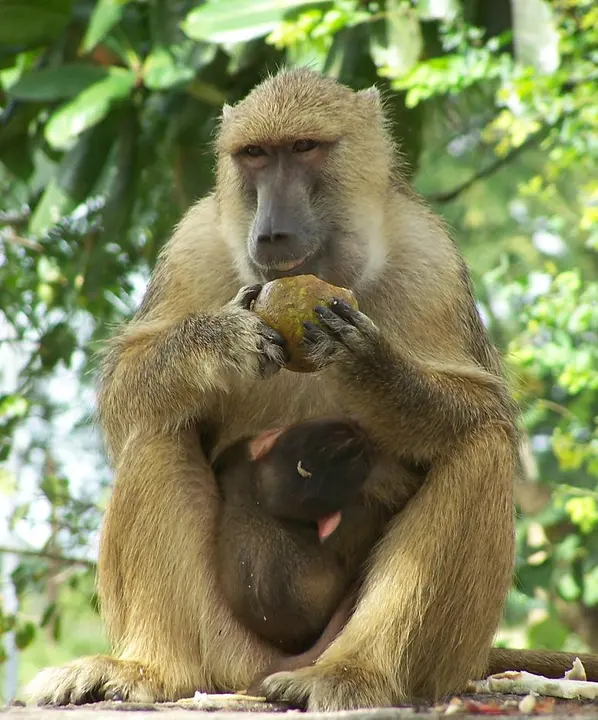
The yellow baboon is a baboon in the family of Old World monkeys. The species epithet means "dog-head" in Greek, due to the dog-like shape of the muzzle and head. Yellow baboons have slim bodies with long arms and legs along with yellowish-brown hair.
They resemble the chacma baboon, but are somewhat smaller and with a less elongated muzzle. Their hairless faces are black, framed with white sideburns. Males can grow to about 84 cm (33 in), females to about 60 cm (24 in). They have long tails which grow to be nearly as long as their bodies. The average life span of the yellow baboon in the wild is roughly 15–20 years; some may live up to 30 years. Yellow baboons inhabit savannas and light forests in eastern Africa, from Kenya and Tanzania to Zimbabwe and Botswana. They are diurnal, terrestrial, and live in complex, mixed-gender social groups of 8 to 200 individuals per troop.
Behaviour
Yellow baboons use at least ten different vocalizations to communicate. When traveling as a group, males will lead, females and young stay safely in the middle, and less-dominant males bring up the rear. A baboon group's hierarchy is a serious matter, and some subspecies have developed behaviors intended to avoid confrontation and retaliation. For example, males may use infants as a kind of "passport" or shield for safe approach toward another male.
Where the Yellow baboon lives
Recorded in Kenya, Tanzania, Malawi, Zambia and Benin (Africa).
Most records fall in Coast, Rift Valley, Morogoro, Muchinga, Pwani and Iringa.
See the Yellow baboon’s range on the globe
Conservation status
Least concern (LC). Not at risk: it is doing well in the wild. Categories are the IUCN Red List as republished by GBIF.
Sources
The range is a density of 4,500 georeferenced GBIF records, shown on the continents where it is mainly recorded, not an expert-drawn map. Description from Wikipedia.