Animals / Mammal
Wolverine
Gulo gulo · Mustelidae
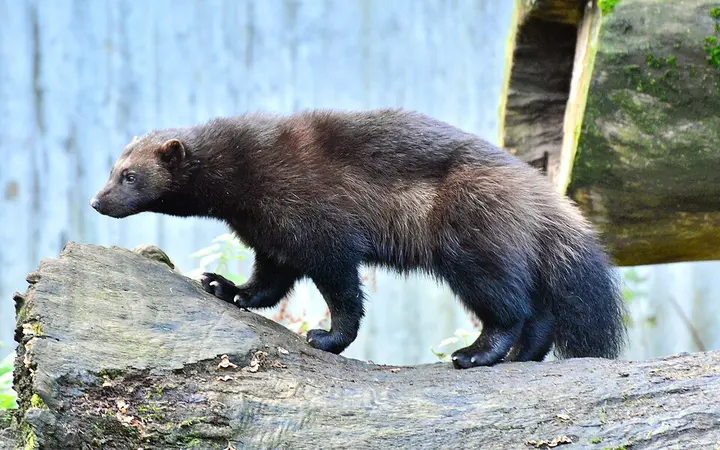
The wolverine, also called the carcajou or quickhatch, is the largest land-dwelling member of the family Mustelidae. It is a muscular carnivore and a solitary animal. The wolverine has a reputation for ferocity and strength out of proportion to its size, with the documented ability to kill prey many times larger than itself.
The wolverine is found primarily in remote reaches of the northern boreal forests and subarctic and alpine tundra of the Northern Hemisphere, with the greatest numbers in Northern Canada, the U.S. state of Alaska, the mainland Nordic countries of Europe, and throughout western Russia and Siberia. Its population has steadily declined since the 19th century owing to trapping, range reduction and habitat fragmentation. The wolverine has become essentially absent from the southern end of its range in both Europe and North America.
Appearance
Anatomically, the wolverine is an elongated animal that is low to the ground. With strong limbs, broad and rounded head, small eyes and short rounded ears, it most closely resembles a large fisher. Though its legs are short, its large, five-toed paws with crampon-like claws and plantigrade posture enable it to climb up and over steep cliffs, trees and snow-covered peaks with relative ease.
Behaviour
Wolverines are primarily scavengers. Most of their food is carrion, especially in winter and early spring. They may find carrion themselves, feed on it after the predator (often, a wolf pack) has finished, or simply take it from another predator. Wolverines are known to follow wolf and lynx trails to scavenge the remains of their kills.
Diet
Wolverines are primarily scavengers. Most of their food is carrion, especially in winter and early spring. They may find carrion themselves, feed on it after the predator (often, a wolf pack) has finished, or simply take it from another predator. Wolverines are known to follow wolf and lynx trails to scavenge the remains of their kills.
Habitat
Wolverines live primarily in isolated arctic, boreal, and alpine regions of northern Canada, Alaska, Siberia, and Fennoscandia; they are also native to European Russia, the Russian Far East, northeast China and Mongolia. Wolverine remains have been found in Ukraine, but they were extirpated and it is unclear whether the wolverines would have formed sustainable populations. The species was present in Scotland until 6,000 BC.
Life cycle
Wolverines are induced ovulators. Successful males will form lifetime relationships with two or three females, which they will visit occasionally, while other males are left without a mate. Mating season is in the summer, but the actual implantation of the embryo (blastocyst) in the uterus is stayed until early winter, delaying the development of the fetus. Females will often not produce young if food is scarce.
Where the Wolverine lives
Recorded in Norway, Sweden, Canada, United States of America, Finland and Russia (Europe and North America).
Most records fall in Oppland, Nordland, Nord-Trøndelag, Hedmark, Finnmark and Sør-Trøndelag.
See the Wolverine’s range on the globe
Conservation status
Least concern (LC). Not at risk: it is doing well in the wild. Categories are the IUCN Red List as republished by GBIF.
Sources
The range is a density of 31,860 georeferenced GBIF records, shown on the continents where it is mainly recorded, not an expert-drawn map. Description from Wikipedia.