Animals / Mammal
Wolf
Canis lupus · Canidae
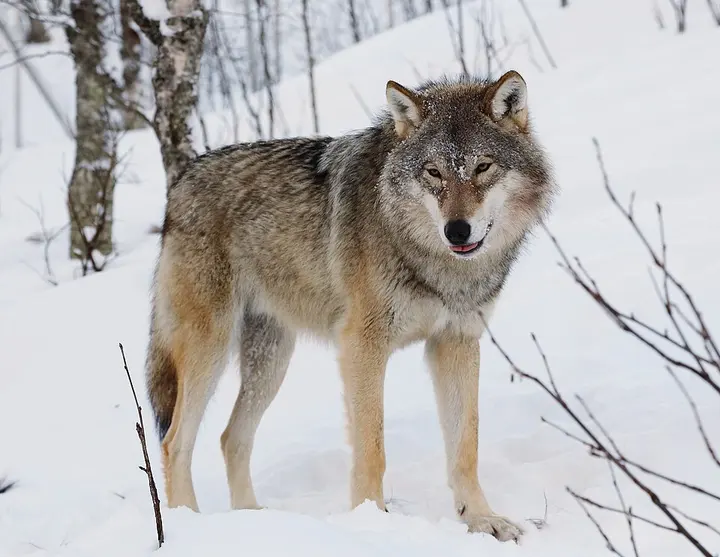
The wolf, also known as the grey wolf or gray wolf, is a canine native to Eurasia and North America. More than thirty subspecies of Canis lupus have been recognized, including the dog and dingo, though grey wolves, as popularly understood, include only naturally occurring wild subspecies. The wolf is the largest wild extant member of the family Canidae, and is further distinguished from other Canis species by its less pointed ears and muzzle, as well as a shorter torso and a longer tail.
The wolf is nonetheless related closely enough to smaller Canis species, such as the coyote and the golden jackal, to produce fertile hybrids with them. The wolf's fur is usually mottled white, brown, grey, and black, although subspecies in the arctic region may be nearly all white. Of all members of the genus Canis, the wolf is most specialized for cooperative game hunting, as demonstrated by its physical adaptations to tackling large prey, its more social nature, and its highly advanced expressive behaviour, including individual or group howling. It travels in nuclear families, consisting of a mated pair accompanied by their offspring. Offspring may leave to form their own packs on the onset of sexual maturity and in response to competition for food within the pack.
Appearance
The wolf is the largest extant member of the family Canidae, and is further distinguished from coyotes and jackals by a broader snout, shorter ears, a shorter torso and a longer tail. It is slender and powerfully built, with a large, deeply descending rib cage, a sloping back, and a heavily muscled neck.
Behaviour
Wolves occur across Eurasia and North America. However, deliberate human persecution because of livestock predation and fear of attacks on humans has reduced the wolf's range to about one-third of its historic range; the wolf is now extirpated (locally extinct) from much of its range in Western Europe, the United States and Mexico, and completely in the British Isles and Japan. In modern times, the wolf occurs mostly in wilderness and remote areas.
Diet
Like all land mammals that are pack hunters, the wolf feeds predominantly on ungulates that can be divided into large size 240–650 kg (530–1,430 lb) and medium size 23–130 kg (51–287 lb), and have a body mass similar to that of the combined mass of the pack members. The wolf specializes in preying on the vulnerable individuals of large prey, with a pack of 15 able to bring down an adult moose.
Habitat
Wolves occur across Eurasia and North America. However, deliberate human persecution because of livestock predation and fear of attacks on humans has reduced the wolf's range to about one-third of its historic range; the wolf is now extirpated (locally extinct) from much of its range in Western Europe, the United States and Mexico, and completely in the British Isles and Japan. In modern times, the wolf occurs mostly in wilderness and remote areas.
Where the Wolf lives
Recorded in France, Switzerland, Norway, Israel, United States of America, Spain, Canada, Italy and Poland (Europe, Asia and North America).
Most records fall in Vaud, Hedmark, HaDarom, Côte-d'Or, Alaska and Alpes-de-Haute-Provence.
See the Wolf’s range on the globe
Conservation status
Least concern (LC). Not at risk: it is doing well in the wild. Categories are the IUCN Red List as republished by GBIF.
Sources
The range is a density of 105,758 georeferenced GBIF records, shown on the continents where it is mainly recorded, not an expert-drawn map. Description from Wikipedia.