Animals / Mammal
Wild yak
Bos mutus · Bovidae
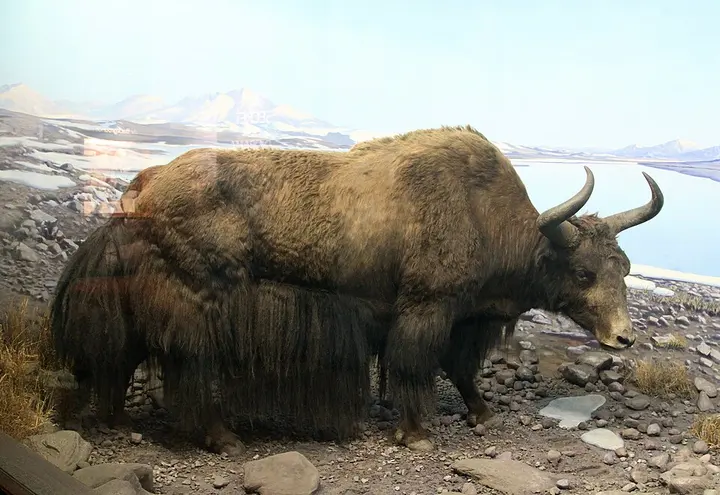
The wild yak is a large, wild bovine native to the Himalayas. It is the ancestor of the domestic yak.
Appearance
The wild yak is heavily built with a bulky frame, sturdy legs, and rounded cloven hooves. To protect against the cold, the udder in females and the scrotum in males are small, and covered in a layer of hair. Females have four teats. Both sexes have long shaggy hair, with a dense woolly undercoat over the chest, flanks, and thighs for insulation against the cold. In males especially, this undercoat may form a long "skirt" that can reach the ground.
Behaviour
The diet of wild yaks consists largely of grasses and sedges, such as Carex, Stipa, and Kobresia. They also eat a smaller amount of herbs, winterfat shrubs, and mosses, and have even been reported to eat lichen. Historically, the main natural predator of the wild yak has been the Himalayan wolf, but Himalayan black bears, Himalayan brown bears and snow leopards have also been reported as predators in some areas, likely of young or infirm wild yaks.
Habitat
The wild yak once ranged up to southern Siberia to the east of Lake Baikal. Fossil remains were recovered in Denisova Cave. Today, the wild yak occurs primarily in northern Tibet and western Qinghai, extending into the southernmost parts of Xinjiang and into Ladakh in India; small, isolated populations of wild yak also live farther afield, primarily in western Tibet and eastern Qinghai.
Life cycle
Wild yaks mate in summer and give birth to a single calf the following spring. Females typically only give birth every other year.
Where the Wild yak lives
Recorded in China, India, Russia, Mongolia, Nepal and Bhutan (Asia).
Most records fall in Qinghai, Xizang, Sichuan, Gorno-Altay, Xinjiang and Yunnan.
See the Wild yak’s range on the globe
Conservation status
Vulnerable (VU). At risk: it could become endangered. Categories are the IUCN Red List as republished by GBIF.
Sources
The range is a density of 1,100 georeferenced GBIF records, shown on the continents where it is mainly recorded, not an expert-drawn map. Description from Wikipedia.