Animals / Bird
Wild turkey
Meleagris gallopavo · Phasianidae
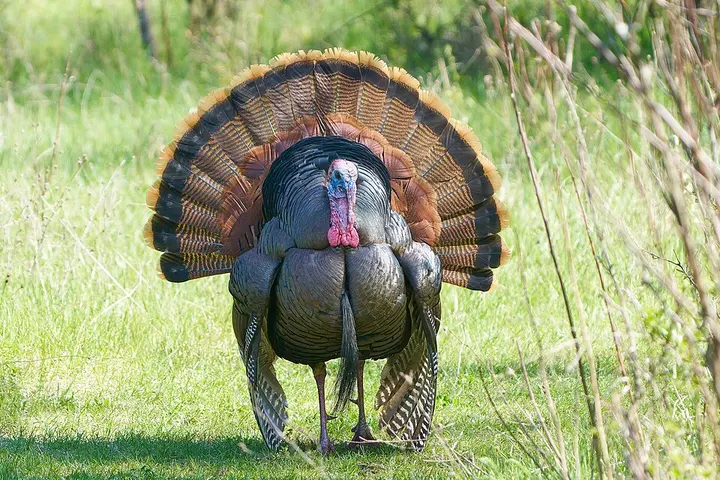
The wild turkey is an upland game bird native to North America, one of two extant species of turkey and the heaviest member of the order Galliformes. It is the ancestor to the domestic turkey, which was originally derived from a southern Mexican subspecies of wild turkey.
Appearance
An adult male (tom or gobbler) normally weighs from 5 to 11 kg (11 to 24 lb) and measures 100–125 cm (39–49 in) in length. The adult female (hen) is typically much smaller at 2.5–5.4 kg (5.5–11.9 lb) and is 76 to 95 cm (30 to 37 in) long. Per two large studies, the average weight of adult males is 7.6 kg (17 lb) and the average weight of adult females is 4.26 kg (9.4 lb).
Behaviour
Despite their weight, wild turkeys, unlike their domesticated counterparts, are agile, fast fliers. In ideal habitat of open woodland or wooded grasslands, they may fly beneath the canopy top and find perches. They usually fly close to the ground for no more than 400 m (a quarter mile). Wild turkeys have very good eyesight during the day. However, their vision is very poor at night so at twilight most turkeys will roost well off the ground in trees for safety.
Diet
Wild turkeys are omnivorous, foraging on the ground or climbing shrubs and small trees to feed. They prefer eating acorns, nuts, and other hard mast of various trees, including hazel, chestnut, hickory, and pinyon pine, as well as various seeds, berries such as juniper and bearberry, buds, leaves, fern fronds, roots, and insects. Turkeys also occasionally consume amphibians such as salamanders and small reptiles such as lizards and small snakes.
Habitat
Wild turkeys prefer hardwood and mixed conifer-hardwood forests with scattered openings such as pastures, fields, orchards and seasonal marshes. They seemingly can adapt to virtually any dense native plant community as long as coverage and openings are widely available. Open, mature forest with a variety of interspersion of tree species appear to be preferred.
Where the Wild turkey lives
Recorded in United States of America and Canada (North America).
Most records fall in California, Ontario, Wisconsin, Michigan, Massachusetts and New York.
See the Wild turkey’s range on the globe
Conservation status
Least concern (LC). Not at risk: it is doing well in the wild. Categories are the IUCN Red List as republished by GBIF.
Sources
The range is a density of 2,844,867 georeferenced GBIF records, shown on the continents where it is mainly recorded, not an expert-drawn map. Description from Wikipedia.