Animals / Mammal
Wild boar
Sus scrofa · Suidae
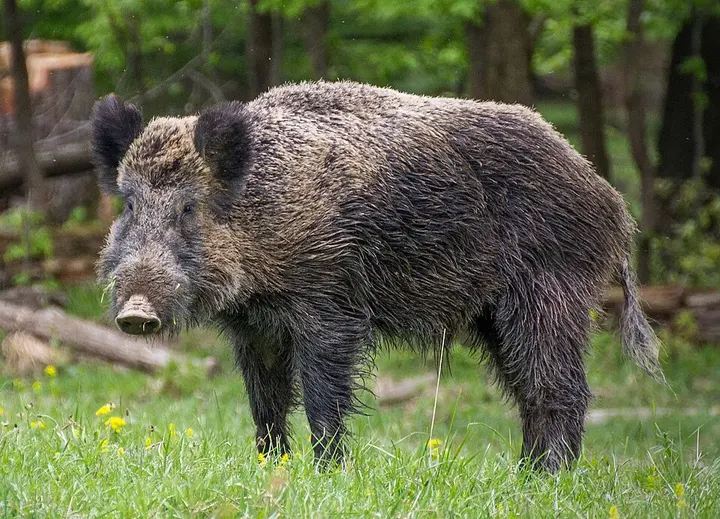
The wild boar, also known as the wild swine, common wild pig, Eurasian wild pig, or simply wild pig, is a suid native to much of Eurasia and North Africa and has been introduced to the Americas and Oceania. The species is now one of the widest-ranging mammals in the world as well as the most widespread suiform. It has been assessed as least concern on the IUCN Red List due to its wide range, high numbers, and adaptability to a diversity of habitats.
It has become an invasive species in part of its introduced range. Wild boars probably originated in Southeast Asia during the Early Pleistocene and outcompeted other suid species as they spread throughout the Old World. However, extensive interspecific introgression among suids has complicated the reconstruction of wild boar origins. A 2026 genomic study instead placed their origin in tropical continental Asia, with wild boars expanding from South Asia during the Middle Pleistocene and later spreading into Southeast Asian islands and across Eurasia. As of 2005, up to 16 subspecies are recognized, which are divided into four regional groupings based on skull height and lacrimal bone length.
Appearance
The wild boar is a bulky, massively built suid with short and relatively thin legs. The trunk is short and robust, while the hindquarters are comparatively underdeveloped. The region behind the shoulder blades rises into a hump and the neck is short and thick to the point of being nearly immobile. The animal's head is very large, taking up to one-third of the body's entire length. The structure of the head is well suited for digging.
Behaviour
The wild boar inhabits a diverse array of habitats from boreal taigas to deserts. In mountainous regions, it can even occupy alpine zones, occurring up to 1,900 m (6,200 ft) in the Carpathians, 2,600 m (8,500 ft) in the Caucasus and up to 3,600–4,000 m (11,800–13,100 ft) in the mountains in Central Asia and Kazakhstan.
Habitat
The species originally occurred in North Africa and much of Eurasia; from the British Isles to Korea and the Sunda Islands. The northern limit of its range extended from southern Scandinavia to southern Siberia and Japan. Within this range, it was only absent in extremely dry deserts and alpine zones. It was once found in North Africa along the Nile valley up to Khartoum and north of the Sahara.
Where the Wild boar lives
Recorded in France, Switzerland, Spain, Netherlands, Israel, Germany, Belgium, South Korea, Japan and Sweden (Europe, Oceania, Asia and North America).
Introduced, not native, in Ashmore and Cartier Is. and United States of America.
Most records fall in Gelderland, Zürich, New South Wales, Vaud, HaZafon and Northern Territory.
See the Wild boar’s range on the globe
Conservation status
Least concern (LC). Not at risk: it is doing well in the wild. Categories are the IUCN Red List as republished by GBIF.
Sources
The range is a density of 594,690 georeferenced GBIF records, shown on the continents where it is mainly recorded, not an expert-drawn map. Description from Wikipedia.