Animals / Mammal
White-tailed deer
Odocoileus virginianus · Cervidae
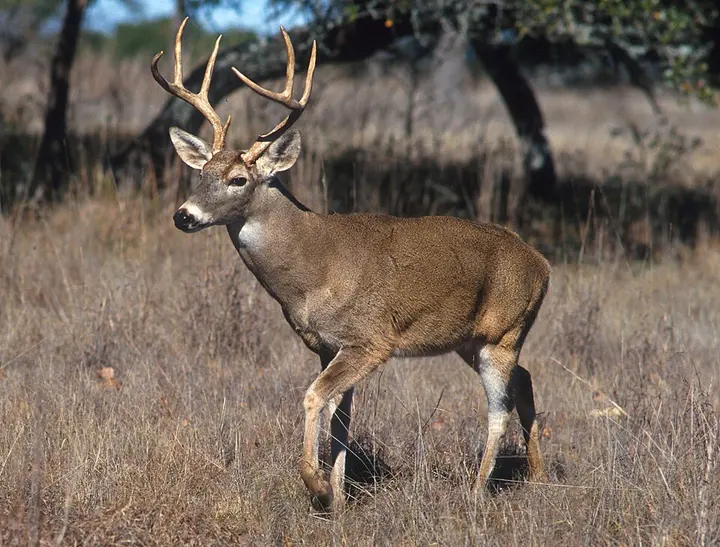
The white-tailed deer, also known commonly as the whitetail and the Virginia deer, is a medium-sized species of deer native to North and South America. It is the most widely distributed mainland ungulate herbivore in the Americas; coupled with its natural predator, the mountain lion, it is one of the most widely distributed terrestrial mammal species in the Americas and the world. Highly adaptable, the various subspecies of white-tailed deer inhabit many different ecosystems, from arid grasslands to the Amazon and Orinoco basins; from the Llanos to the high-elevation terrain of the Andes.
Where the White-tailed deer lives
Recorded in United States of America, Canada, Mexico and Colombia (North America, Europe and South America).
Introduced, not native, in Finland.
Most records fall in Texas, North Carolina, Pennsylvania, Ontario, New York and Virginia.
See the White-tailed deer’s range on the globe
Conservation status
Least concern (LC). Not at risk: it is doing well in the wild. Categories are the IUCN Red List as republished by GBIF.
Sources
The range is a density of 343,689 georeferenced GBIF records, not an expert-drawn map. Description from Wikipedia.