Animals / Mammal
White rhinoceros
Ceratotherium simum · Rhinocerotidae
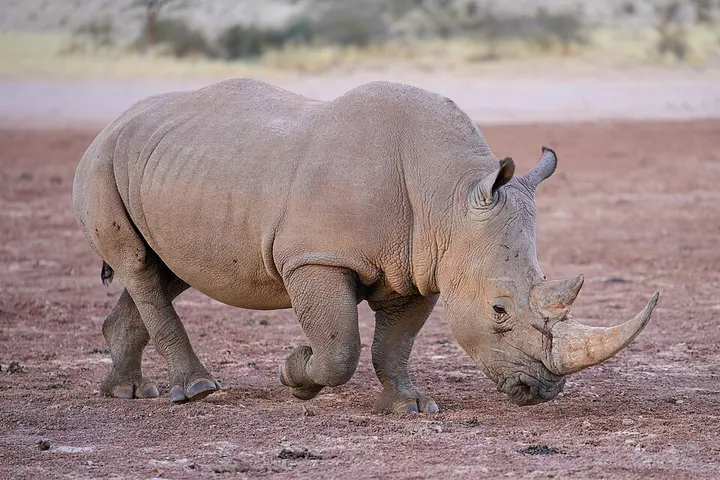
The white rhinoceros, white rhino or square-lipped rhinoceros is the largest extant species of rhinoceros. It has a wide mouth used for grazing and is the most social of all rhino species. The white rhinoceros consists of two subspecies: the southern white rhinoceros, with an estimated 17,464 individuals in the wild as of the end of 2023, and the much rarer northern white rhinoceros.
The northern subspecies is critically endangered and on the brink of extinction; it has only two confirmed left as of 2018 (two females: Fatu, 24 and Najin, 29, both in captivity at Ol Pejeta). Sudan, the world's last known male northern white rhinoceros, died in Kenya in March 2018. White rhinoceros can run up to 40 mph (64 km/h) for very short bursts. They can maintain speeds of around 30–31 mph (48–50 km/h) for a good amount of time, and they have good stamina.
Appearance
The white rhinoceros is the largest of the five living species of rhinoceros. By mean body mass, the white rhinoceros falls behind only the three extant species of elephant as the largest land animal and terrestrial mammal alive today. It weighs more on average than a hippopotamus despite a considerable mass overlap between these two species. It has a massive body and large head, a short neck and broad chest.
Behaviour
White rhinos are grazing herbivores. They are found in grassland and savannah habitat. Preferring the shortest grains, the white rhinoceros is one of the largest pure grazers. It drinks twice a day if water is available, but if conditions are dry it can live four or five days without water. It spends about half of the day eating, one-third resting, and the rest of the day doing various other things.
Habitat
The southern white rhino lives in Southern Africa. About 98.5% of white rhinos live in just five countries (South Africa, Namibia, Zimbabwe, Kenya, and Uganda). Almost at the edge of extinction in the early 20th century, the southern subspecies have made a tremendous comeback. In 2001, it was estimated that there were 11,670 white rhinos in the wild, with a further 777 in captivity worldwide, making it the most common rhino in the world.
Life cycle
Cows reach sexual maturity at 6–7 years of age while bulls reach sexual maturity between 10 and 12 years of age. Courtship is often a difficult affair. The bull stays beyond the point where the cow acts aggressively and will give out a call when approaching her. The bull chases and or blocks the way of the cow while squealing or wailing loudly if the cow tries to leave his territory.
Where the White rhinoceros lives
Recorded in South Africa, Kenya, Namibia, Uganda, Zimbabwe, Botswana and eSwatini (Africa).
Most records fall in Mpumalanga, KwaZulu-Natal, Rift Valley, Limpopo, North West and Nairobi.
See the White rhinoceros’s range on the globe
Conservation status
Near threatened (NT). Not at risk yet, but could be soon. Categories are the IUCN Red List as republished by GBIF.
Sources
The range is a density of 5,473 georeferenced GBIF records, shown on the continents where it is mainly recorded, not an expert-drawn map. Description from Wikipedia.