Animals / Bird
White-breasted nuthatch
Sitta carolinensis · Sittidae
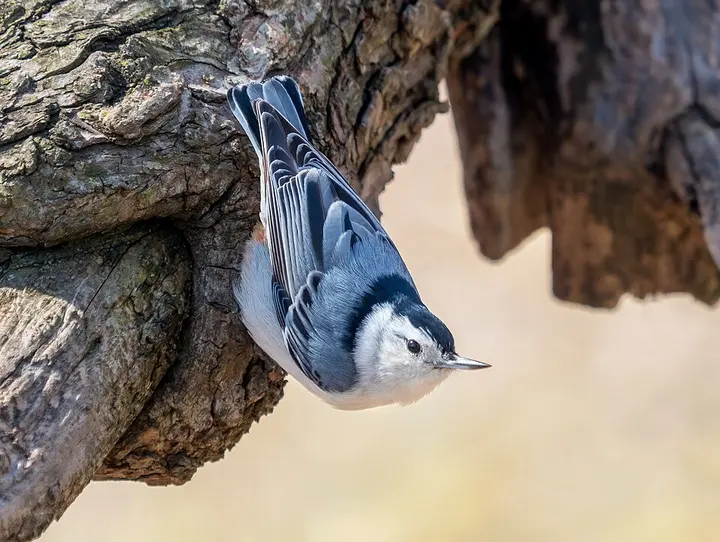
The white-breasted nuthatch is a species of bird in the nuthatch family Sittidae. It is a medium-sized nuthatch, measuring approximately 15.5 cm (6.1 in) in length. Coloration varies somewhat along the species' range, but the upperparts are light blue-gray, with a black crown and nape in males, while females have a dark gray crown.
The underparts are whitish, with a reddish tinge on the lower abdomen. Despite not being closely related, the white-breasted nuthatch and the white wagtail are very similar in plumage. The white-breasted nuthatch is a chatty bird. It has a nasal voice and often utters little cries or vocalizations, often composed of repetitions of small invariant whistles. In summer, it is an exclusively insectivorous bird, consuming a wide range of arthropods, but in winter its diet consists mainly of seeds. The nest is located in the cavity of a tree. The clutch consists of five to nine eggs, incubated for two weeks by the female, who is fed by the male. The two adults then feed the young until they fledge, and for a few weeks after that.
Appearance
The white-breasted nuthatch is a medium-sized nuthatch, measuring about 15.5 cm (6.1 in) in length. Like other members of its genus, it has a large head, short tail, short wings, a powerful bill and strong feet; it is 13–14 cm (5.1–5.5 in) long, with a wingspan of 20–27 cm (7.9–10.6 in) and a weight of 18–30 g (0.63–1.06 oz).
Behaviour
The white-breasted nuthatch often travels with small mixed flocks in winter. These flocks are led by titmice and chickadees, with nuthatches and downy woodpeckers as common attendant species. Participants in such flocks are thought to benefit in terms of foraging and predator avoidance. It is likely that the attendant species also access the information carried in the chickadees' calls and reduce their own level of vigilance accordingly.
Diet
The white-breasted nuthatch forages along tree trunks and branches in a similar way to woodpeckers and treecreepers, but does not use its tail for additional support, instead progressing in jerky hops using its strong legs and feet. All nuthatches are distinctive when seeking food because they are able to descend tree trunks head-first and can hang upside-down beneath twigs and branches. The white-breasted nuthatch is omnivorous, eating insects and seeds.
Habitat
The breeding habitat of the white-breasted nuthatch is woodland across North America, from southern Canada to northern Florida and southern Mexico. In the eastern part of its range, its preferred habitat is old-growth open deciduous or mixed forest, including orchards, parks, suburban gardens and cemeteries; it is found mainly in the lowlands, although it breeds at 1,675 m (5,495 ft) elevation in Tennessee.
Where the White-breasted nuthatch lives
Recorded in United States of America and Canada (North America).
Most records fall in New York, Pennsylvania, Ontario, Michigan, Massachusetts and Ohio.
See the White-breasted nuthatch’s range on the globe
Conservation status
Least concern (LC). Not at risk: it is doing well in the wild. Categories are the IUCN Red List as republished by GBIF.
Sources
The range is a density of 14,333,941 georeferenced GBIF records, shown on the continents where it is mainly recorded, not an expert-drawn map. Description from Wikipedia.