Animals / Mammal
White-bellied pangolin
Phataginus tricuspis · Manidae
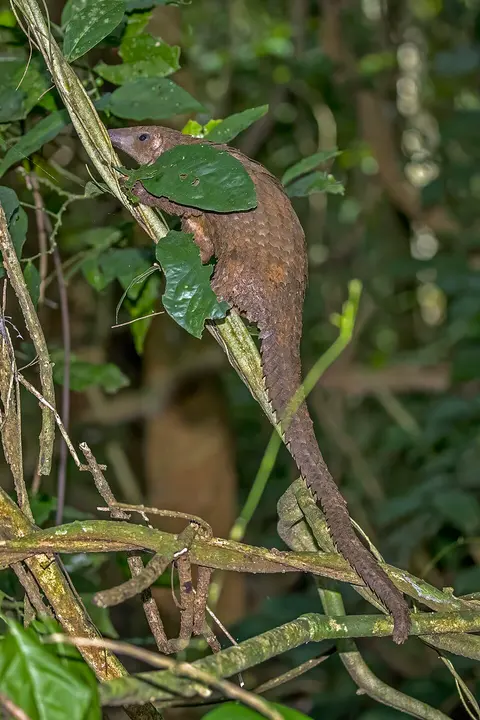
The white-bellied pangolin is one of eight extant species of pangolins, and is native to equatorial Africa. Also known as the tree pangolin or three-cusped pangolin, it is the most common of the African forest pangolins.
Behaviour
The white-bellied pangolin can walk on all fours or on its hind legs using its prehensile tail for balance. It can climb up trees in the absence of branches. When walking on all fours, it walks on its front knuckles with its claws tucked underneath to protect them from wearing down. Its anal scent glands disperse a foul secretion much like a skunk when threatened. It has a well-developed sense of smell, but as a nocturnal animal, it has poor eyesight.
Diet
The white-bellied pangolin eats insects such as ants and termites from their nests, or the armies of insects moving on the trees. This form of diet is called myrmecophagy. It relies on its thick skin for protection, and digs into burrows with its long, clawed forefeet. It eats between 5 and 7 ounces (150 to 200 g) of insects a day. The pangolin uses its 10- to 27-in (250- to 700-mm) tongue which is coated with gummy alkaline mucus to funnel the insects into its mouth.
Life cycle
Female pangolin territories are solitary and small, less than 10 acres (4 ha), and they rarely overlap. Males have larger territories, up to 60 acres (24 ha), which overlap many female territories, resulting in male/female meetings. Pangolins can demonstrate their availability through feces and urine markings as well as by spreading the scent produced by their anal glands. The meetings between males and females are brief unless the female is in estrus, when mating occurs.
Where the White-bellied pangolin lives
Recorded in Dem. Rep. Congo, Côte d'Ivoire, Benin, Ghana, Cameroon, Nigeria, Liberia, Gabon, Central African Rep., Uganda, Eq. Guinea, Angola and Congo (Africa).
Most records fall in Orientale, Lagunes, Bas-Sassandra, Eastern, Sud and Haut-Ogooué.
See the White-bellied pangolin’s range on the globe
Conservation status
Endangered (EN). In danger of dying out in the wild. Categories are the IUCN Red List as republished by GBIF.
Sources
The range is a density of 416 georeferenced GBIF records, shown on the continents where it is mainly recorded, not an expert-drawn map. Description from Wikipedia.