Animals / Bird
White-backed vulture
Gyps africanus · Accipitridae
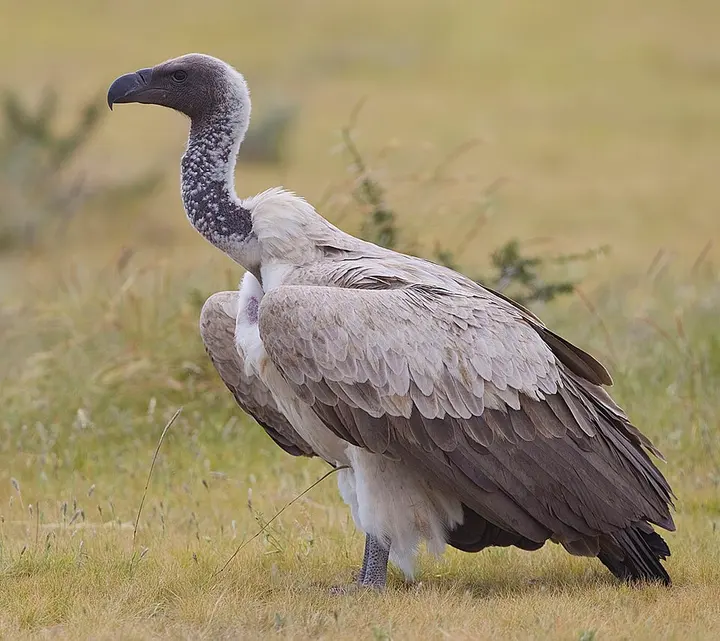
The white-backed vulture is an Old World vulture in the family Accipitridae, which also includes eagles, kites, buzzards and hawks. It is the most common vulture species in the continent of Africa.
Appearance
The white-backed vulture is a typical vulture, with only down feathers on the head and neck, very broad wings and short tail feathers. It has a white neck ruff. The adult's whitish back contrasts with the otherwise dark plumage. Juveniles are largely dark. This is a medium-sized vulture; its body mass is 4.2 to 7.2 kg (9.3–15.9 lb), it is 78 to 98 cm (31 to 39 in) long and has a 1.96 to 2.25 m (6 ft 5 in to 7 ft 5 in) wingspan.
Behaviour
White-backed vultures are obligate scavengers with a high level of specialization on carrion and bone fragments. Their primary food sources are the carcasses of large, grazing animals found in the wooded savannahs where it lives. This includes warthogs, zebras, gazelles, rhinoceroses, buffalos especially African buffalos, ostriches and even livestock.
Diet
White-backed vultures are obligate scavengers with a high level of specialization on carrion and bone fragments. Their primary food sources are the carcasses of large, grazing animals found in the wooded savannahs where it lives. This includes warthogs, zebras, gazelles, rhinoceroses, buffalos especially African buffalos, ostriches and even livestock.
Habitat
The white-backed vulture occurs from Senegal, Gambia and Mali in the west, throughout the Sahel region to Ethiopia and Somalia in the east, through East Africa into Mozambique, Zimbabwe, Botswana, Namibia and South Africa in the south. It is the most widespread and common vulture in Africa with an estimated range of 24,300,000 km2 (9,400,000 sq mi), but has undergone rapid population declines in recent years.
Life cycle
White-backed vultures nest in trees. They typically choose tall trees along riparian habitats and show a strong preference for Acacia species. The nests are large, around 1m in diameter, and are made of large sticks and lined with leaves and grasses. A study which monitored 32 African white-backed vulture nests in the Masai Mara National Reserve during the period 2003 to 2007 showed that the mean nesting success was 59%.
Where the White-backed vulture lives
Recorded in South Africa, Kenya, Tanzania, Namibia, Botswana, Zimbabwe, Uganda, Zambia and Ethiopia (Africa).
Most records fall in Mpumalanga, Limpopo, Rift Valley, KwaZulu-Natal, North-West and Northern Cape.
See the White-backed vulture’s range on the globe
Conservation status
Critically endangered (CR). In very great danger of dying out in the wild. Categories are the IUCN Red List as republished by GBIF.
Sources
The range is a density of 147,757 georeferenced GBIF records, shown on the continents where it is mainly recorded, not an expert-drawn map. Description from Wikipedia.