Animals / Fish
Whale shark
Rhincodon typus · Rhincodontidae
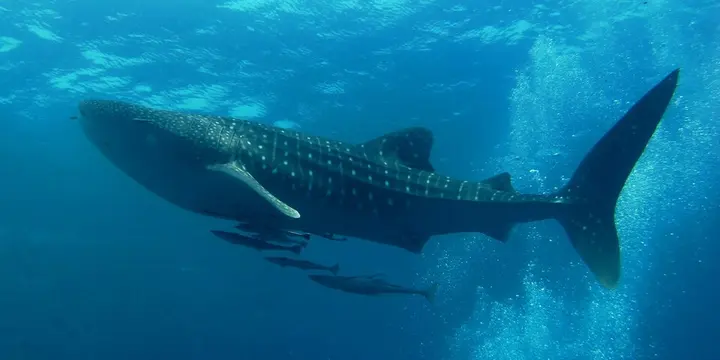
The whale shark is a slow-moving, filter-feeding carpet shark and the largest known extant fish species. An individual with a length of 18.8 m (61.7 ft) has been considered the largest reliably recorded. The whale shark holds many records for size in the animal kingdom, most notably being by far the largest living non-cetacean animal.
It is the only living species of the genus Rhincodon and the only extant member of the family Rhincodontidae, which belongs to the subclass Elasmobranchii in the class Chondrichthyes. Before 1984, it was classified as Rhiniodon into Rhinodontidae. An extinct species, Rhincodon ferriolensis, was described in Europe (probably in Spain), in the Late Burdigalian stage. The whale shark is an active filter feeder, primarily consuming plankton, krill, fish eggs, and small schooling fish such as sardines and anchovies. The shark can process over 6,000 liters of water per hour through its specialized sieve-like gill pads.
Appearance
Whale sharks possess a broad, flattened head with a large mouth and two small eyes located at the front corners. Unlike many other sharks, whale shark mouths are located at the front of the head rather than on the underside of the head. Their mouths can be exceptionally wide; a 12.1 m (39.7 ft) individual was reported to have a mouth measuring 1.55 m (5.1 ft) across. Whale shark mouths can contain over 300 rows of tiny teeth and 20 filter pads which it uses to filter feed.
Diet
The whale shark is a filter feeder – one of only three known filter-feeding shark species (along with the basking shark and the megamouth shark). It feeds on plankton including copepods, krill, chaetognaths, jellyfish, fish eggs, Christmas Island red crab larvae and small nektonic life, such as small squid or fish (sardines, anchovies, mackerels and small tunas). It also feeds on clouds of eggs during mass spawning of fish and corals.
Habitat
The whale shark inhabits all tropical and warm-temperate seas. The fish is primarily pelagic, and can be found in both coastal and oceanic habitats. Tracking devices have shown that the whale shark displays dynamic patterns of habitat utilization, likely in response to availability of prey.
Where the Whale shark lives
Recorded in Ashmore and Cartier Is., Ecuador, Mexico, Indonesia, Maldives, Peru and Philippines (Oceania, South America, North America, Asia and Seven seas (open ocean)).
Most records fall in Western Australia, Quintana Roo, Queensland, Alifu Dhaalu, Baja California Sur and Thaa.
See the Whale shark’s range on the globe
Conservation status
Endangered (EN). In danger of dying out in the wild. Categories are the IUCN Red List as republished by GBIF.
Sources
The range is a density of 15,497 georeferenced GBIF records, shown on the continents where it is mainly recorded, not an expert-drawn map. Description from Wikipedia.