Animals / Insect
Western honey bee
Apis mellifera · Apidae
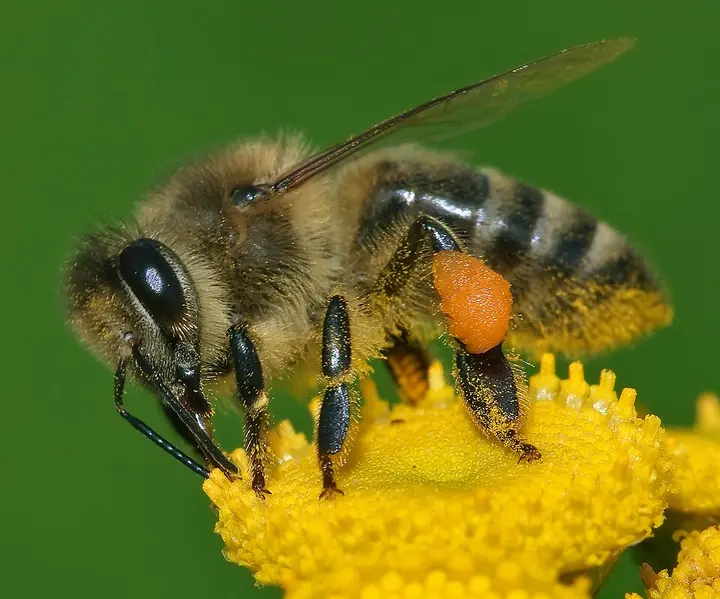
The western honey bee is the most common of the 7–12 species of honey bees worldwide. The genus name Apis is Latin for 'bee', and mellifera is the Latin for 'honey-bearing' or 'honey-carrying', referring to the species' production of honey.
Like all honey bee species, the western honey bee is eusocial, creating colonies with a single fertile female (or "queen"), many normally non-reproductive females or "workers", and a small proportion of fertile males or "drones". Individual colonies can house tens of thousands of bees. Colony activities are organized by complex communication between individuals, through both pheromones and the waggle dance. The western honey bee was one of the first domesticated insects, and it is the primary species maintained by beekeepers to this day for both its honey production and pollination activities. With human assistance, the western honey bee now occupies every continent except Antarctica.
Behaviour
The western honey bee needs an internal body temperature of 35 °C (95 °F) to fly; this temperature is maintained in the nest to develop the brood, and is the optimal temperature for the creation of wax. The temperature on the periphery of the cluster varies with outside air temperature, and the winter cluster's internal temperature may be as low as 20–22 °C (68–72 °F).
Habitat
The western honey bee can be found on every continent except Antarctica. The species is believed to have originated in Africa or Asia, and it spread naturally through Africa, the Middle East and Europe. Humans are responsible for its considerable additional range, introducing European subspecies into North America (early 1600s), South America, Australia, New Zealand, and eastern Asia.
Life cycle
Unlike most other bee species, western honey bees have perennial colonies which persist year after year. Because of this high degree of sociality and permanence, western honey bee colonies can be considered superorganisms. This means that reproduction of the colony, rather than individual bees, is the biologically significant unit. Western honey bee colonies reproduce through a process called "swarming".
Where the Western honey bee lives
Recorded in Netherlands, Poland, Germany, United Kingdom, France and Belgium (North America, Europe and Oceania).
Introduced, not native, in United States of America, Canada, Ashmore and Cartier Is. and Mexico.
Most records fall in Greater Poland, California, Texas, Nordrhein-Westfalen, Zuid-Holland and Gelderland.
See the Western honey bee’s range on the globe
Conservation status
Not evaluated (NE). Scientists haven’t checked yet how at risk it is, so this doesn’t mean it is safe or in danger. Categories are the IUCN Red List as republished by GBIF.
Sources
The range is a density of 1,279,107 georeferenced GBIF records, shown on the continents where it is mainly recorded, not an expert-drawn map. Description from Wikipedia.