Animals / Mammal
Western gorilla
Gorilla gorilla · Hominidae
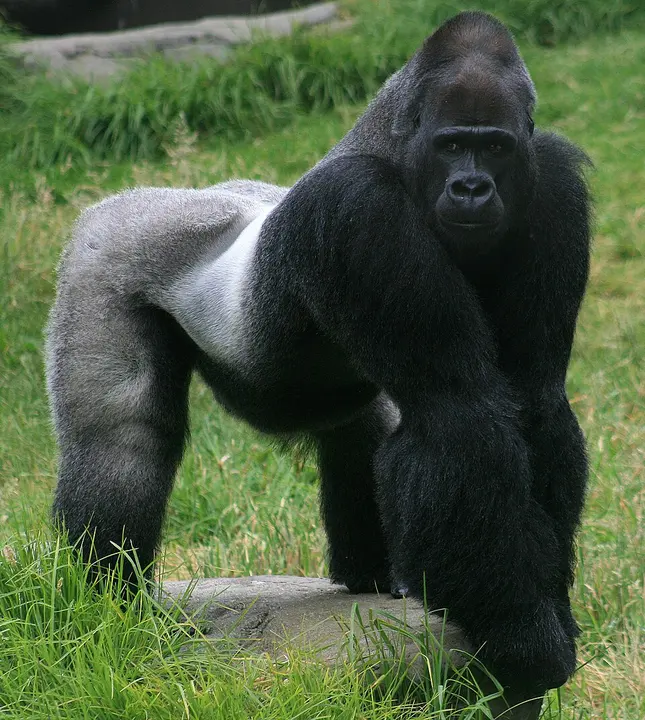
The western gorilla is a great ape found in Africa, one of two species of the hominine genus Gorilla. Large and robust with males weighing around 168 kilograms (370 lb), the species is found in a region of midwest Africa, geographically isolated from the eastern gorilla. The hair of the western species is significantly lighter in colour.
The western gorilla is the second largest living primate after the eastern gorilla. Two subspecies are recognised: the western lowland gorilla (Gorilla gorilla gorilla) is found in most of West Africa; while the Cross River gorilla (Gorilla gorilla diehli) is limited to a smaller range in the north at the border of Cameroon and Nigeria. Both subspecies are critically endangered.
Appearance
Western gorillas are generally lighter coloured than eastern gorillas. Western gorillas have black, dark grey or dark brown-grey hair with a brownish forehead. Males average 1.67 m (5.5 ft) although reaching a height up to 1.76 m (5.8 ft), with males weighing 145–191 kg (320–421 lb) and females weighing 58–72 kg (128–159 lb). Captive western gorillas average 157 kg (346 lb) in males and 80 kg (176 lb) in females.
Behaviour
Western gorillas live in groups that vary in size from two to twenty individuals. Such groups are composed of at least one male, several females and their offspring. A dominant male silverback heads the group, with younger males usually leaving the group when they reach maturity. Females transfer to another group before breeding, which begins at eight to nine years old; they care for their young infants for the first three to four years of their lives.
Where the Western gorilla lives
Recorded in Gabon, Congo, Cameroon, Central African Rep., Nigeria and Eq. Guinea (Africa).
Most records fall in Sangha, Ogooué-Maritime, Haut-Ogooué, Cuvette-Ouest, Sud-Ouest and Ogooué-Lolo.
See the Western gorilla’s range on the globe
Conservation status
Critically endangered (CR). In very great danger of dying out in the wild. Categories are the IUCN Red List as republished by GBIF.
Sources
The range is a density of 469 georeferenced GBIF records, shown on the continents where it is mainly recorded, not an expert-drawn map. Description from Wikipedia.