Animals / Reptile
Western diamondback rattlesnake
Crotalus atrox · Viperidae
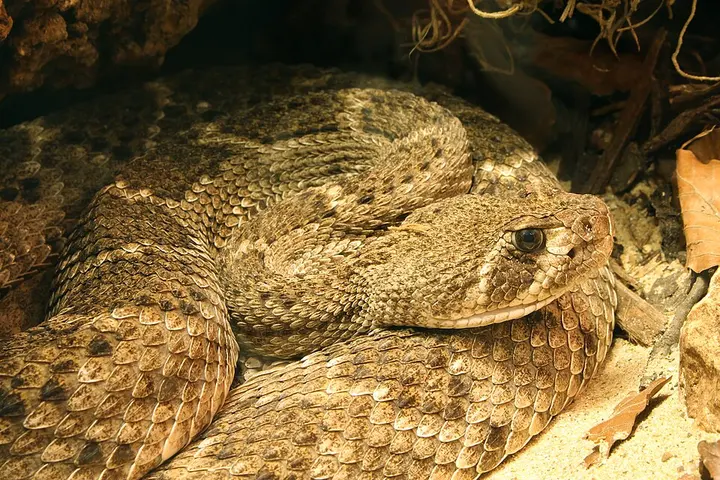
The western diamondback rattlesnake or western diamond-backed rattlesnake, is a rattlesnake species and member of the viper family, found in the southwestern United States and Mexico. Like all other rattlesnakes and all other vipers, it is venomous. It is likely responsible for the majority of snakebite fatalities in northern Mexico and the greatest number of snakebites in the U.S.
No subspecies are currently recognized. It lives in elevations from below sea level up to 6,500 feet (2,000 m). This species ranges throughout the Southwestern United States and northern half of Mexico. Currently, western diamondback rattlesnakes are not threatened or endangered.
Appearance
Adults commonly grow to 120 cm (4 ft) in length. Specimens over 150 cm (5 ft) are infrequently encountered, while those over 180 cm (6 ft) are very rare, and the largest reported length considered to be reliable is 213 cm (7 ft). Males become much larger than females, although this difference in size does not occur until after they have reached sexual maturity.
Behaviour
C. atrox is solitary except during the mating season, when males of the species are single-minded and aggressive in pursuing females. Usually inactive between late October and early March, these ectotherms occasionally may be seen basking in the sun on warm winter days. In the winter, they hibernate or brumate in caves or burrows, sometimes with many other species of snakes.
Habitat
It is found in the United States from central Arkansas to southeastern and Central California, south into Mexico as far as northern Sinaloa, Hidalgo and northern Veracruz. Disjunct populations exist in southern Veracruz and southeastern Oaxaca. The type locality given is "Indianola" (Indianola, Calhoun County, Texas). Rattlesnakes such as the Western Diamondback are common in Texas coastal beaches such as Surfside Beach, Brazoria County, Texas.
Life cycle
Rattlesnakes, including C. atrox, are viviparous. Gestation lasts six or seven months, and broods average about a dozen young. However, the young stay with the mother for only a few hours before they set off on their own to hunt and find cover, so that the mortality rate is very high. Mating occurs in the fall, and the females give birth to as many as 25 young, which may be as long as 30 cm (12 in). The young can deliver a venomous bite from the moment they are born.
Where the Western diamondback rattlesnake lives
Recorded in United States of America and Mexico (North America).
Most records fall in Texas, Arizona, New Mexico, Chihuahua, Oklahoma and Sonora.
See the Western diamondback rattlesnake’s range on the globe
Conservation status
Least concern (LC). Not at risk: it is doing well in the wild. Categories are the IUCN Red List as republished by GBIF.
Sources
The range is a density of 28,394 georeferenced GBIF records, shown on the continents where it is mainly recorded, not an expert-drawn map. Description from Wikipedia.