Animals / Bird
Western bluebird
Sialia mexicana · Turdidae
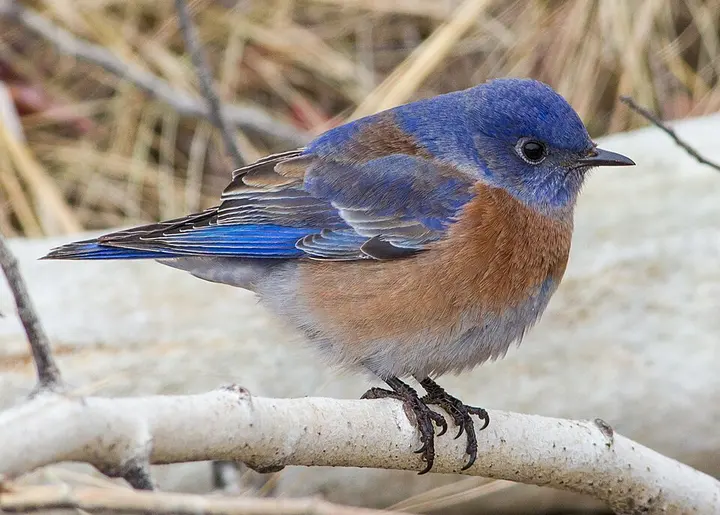
The western bluebird is a small North American thrush.
Appearance
The western bluebird is a small stocky bird with a length of 15 to 18 cm (5.9 to 7.1 in). The adult male is bright blue on top and on the throat with an orange breast and sides, a brownish patch on back, and a gray belly and undertail coverts. The adult female has a duller blue body, wings, and tail, a gray throat, a dull orange breast, and a gray belly and undertail coverts. Both sexes have a thin straight bill with a fairly short tail.
Behaviour
The western bluebird nests in cavities or in nest boxes, competing with tree swallows, house sparrows, and European starlings for natural nesting locations. Because of the high level of competition, house sparrows often attack western bluebirds for their nests. The attacks are made both in groups or alone. Attacks by starlings can be reduced if the nesting box opening is kept to 1.5 in (38 mm) diameter to avoid takeover.
Habitat
The western bluebird has been displaced from its natural habitat by the felling of trees; however it has adapted to coniferous forests, farmlands, semi-open terrain, and desert to survive. The year-round range includes California, the southern Rocky Mountains, Arizona, and New Mexico in the United States, and as far south as the states of Oaxaca and Veracruz in Mexico. The summer breeding range extends as far north as the Pacific Northwest, British Columbia, and Montana.
Life cycle
The western bluebird nests in cavities or in nest boxes, competing with tree swallows, house sparrows, and European starlings for natural nesting locations. Because of the high level of competition, house sparrows often attack western bluebirds for their nests. The attacks are made both in groups or alone. Attacks by starlings can be reduced if the nesting box opening is kept to 1.5 in (38 mm) diameter to avoid takeover.
Where the Western bluebird lives
Recorded in United States of America and Canada (North America).
Most records fall in California, Arizona, New Mexico, Oregon, Colorado and Washington.
See the Western bluebird’s range on the globe
Conservation status
Least concern (LC). Not at risk: it is doing well in the wild. Categories are the IUCN Red List as republished by GBIF.
Sources
The range is a density of 1,645,536 georeferenced GBIF records, shown on the continents where it is mainly recorded, not an expert-drawn map. Description from Wikipedia.