Animals / Mammal
Weddell seal
Leptonychotes weddellii · Phocidae
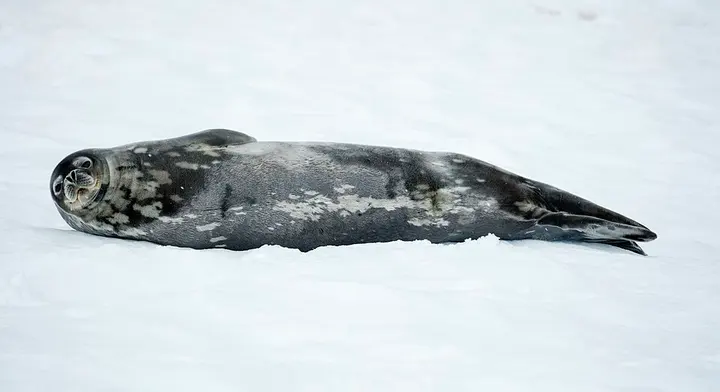
The Weddell seal is a relatively large and abundant true seal with a circumpolar distribution surrounding Antarctica. The Weddell seal was discovered and named in the 1820s during expeditions led by British sealing captain James Weddell to the area of the Southern Ocean now known as the Weddell Sea. The life history of this species is well documented since it occupies fast ice environments close to the Antarctic continent and often adjacent to Antarctic bases.
It is the only species in the genus Leptonychotes.
Appearance
Weddell seals measure about 2.5–3.5 m (8 ft 2 in – 11 ft 6 in) long and weigh 400–600 kg (880–1,320 lb). They are amongst the largest seals, with a rather bulky body and short fore flippers relative to their body length. Males weigh less than females, usually about 500 kg (1,100 lb) or less. Male and female Weddell seals are generally about the same length, though females can be slightly larger.
Behaviour
Weddell seals are commonly found on fast ice, or ice fastened to land, and gather in small groups around cracks and holes within the ice. In the winter, they stay in the water to avoid blizzards, with only their heads poking through breathing holes in the ice. These seals are often observed lying on their sides when on land.
Diet
Weddell seals dive to forage for food, maintain breathing holes in fast ice, and explore to find more ice holes. They have been observed to dive as deep as 600 m for up to an hour. These seals exhibit a diel dive pattern, diving deeper and longer during the day than at night. After dropping away from a breathing hole in the ice, the seals become negatively buoyant in the first 30 to 50 m (98 to 164 ft), allowing them to dive with little effort.
Life cycle
Weddell seals return to fast ice colonies during the spring for birthing and breeding. Weddell seal populations will often return to the same breeding sites over consecutive breeding seasons. Depending on the latitude it inhabits, this marine mammal gives birth from early September through November, with those living at lower latitudes giving birth earlier.
Where the Weddell seal lives
Recorded in Antarctica (Antarctica).
See the Weddell seal’s range on the globe
Conservation status
Least concern (LC). Not at risk: it is doing well in the wild. Categories are the IUCN Red List as republished by GBIF.
Sources
The range is a density of 385,992 georeferenced GBIF records, shown on the continents where it is mainly recorded, not an expert-drawn map. Description from Wikipedia.