Animals / Bird
Wattled crane
Bugeranus carunculatus · Gruidae
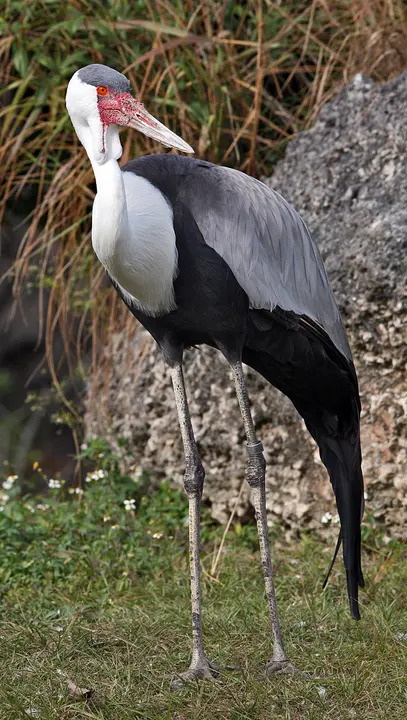
The wattled crane is a large, threatened species of crane found in wetlands and grasslands of eastern and southern Africa, ranging from Ethiopia to South Africa. Some authorities consider it the sole member of the genus Bugeranus.
Appearance
At a height known to range from 150 to 175 cm (4 ft 11 in to 5 ft 9 in), it is the largest crane in Africa and is the second tallest species of crane in the world, after the sarus crane. It is also the tallest flying bird native to Africa third only among all birds to the two species of ostrich.
Behaviour
There does seem to be some seasonal movements in this crane species, but they are not well-known. Movements seem to be dictated by local water conditions rather than by seasonal temperature variations. During local floods, the number of wattled cranes can increase from almost none to as much as 3,000 individuals. These movements, in pursuit of ideal feeding conditions, seem more opportunistic movement rather than a fixed migration pattern.
Habitat
The wattled crane occurs in eleven countries in eastern and southern Africa, including an isolated population in the Ethiopia Highlands. More than half of the world's wattled cranes occur in Zambia, but the single largest concentration occurs in the Okavango Delta of Botswana. The wattled crane has been spotted in Uganda for the first time in 2011, seen in the Kibimba Rice region in the eastern side of the country.
Where the Wattled crane lives
Recorded in South Africa, Botswana, Zambia, Namibia and Ethiopia (Africa).
Most records fall in KwaZulu-Natal, North-West, Caprivi, Mpumalanga, Central and Southern.
See the Wattled crane’s range on the globe
Conservation status
Vulnerable (VU). At risk: it could become endangered. Categories are the IUCN Red List as republished by GBIF.
Sources
The range is a density of 15,042 georeferenced GBIF records, shown on the continents where it is mainly recorded, not an expert-drawn map. Description from Wikipedia.