Animals / Mammal
Waterbuck
Kobus ellipsiprymnus · Bovidae
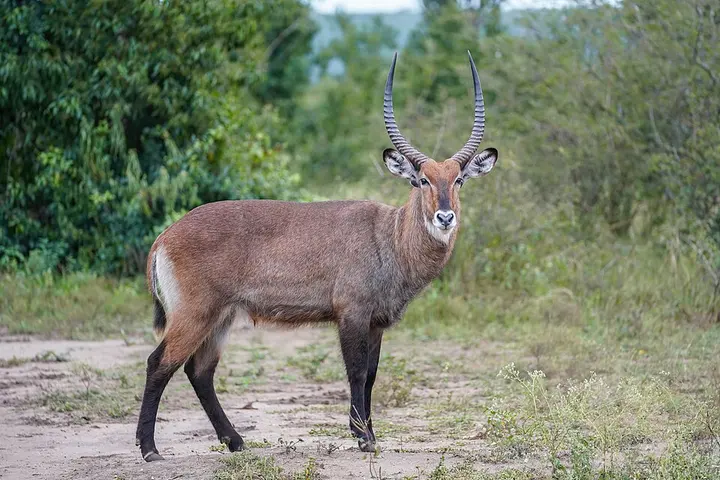
The waterbuck is a large antelope found widely in sub-Saharan Africa. It is in the genus Kobus of the family Bovidae. It was first described by Irish naturalist William Ogilby in 1833.
Its 13 subspecies are grouped under two varieties: the common or ellipsiprymnus waterbuck and the defassa waterbuck. Their coat colour varies from brown to grey. The long, spiral horns, present only on males, curve backward, then forward, and are 55–99 cm (22–39 in) long. Waterbucks are rather sedentary in nature. As gregarious animals, they may form herds consisting of six to thirty individuals. These groups are either nursery herds with females and their offspring or bachelor herds. Males start showing territorial behaviour from the age of five years, but are most dominant from six to nine. The waterbuck cannot tolerate dehydration in hot weather, and thus inhabits areas close to sources of water. Predominantly a grazer, the waterbuck is mostly found on grassland.
Appearance
The waterbuck is the largest amongst the six species of Kobus. It is a sexually dimorphic antelope, with the males nearly 7% taller than females and around 8% longer. The head-and-body length is typically 177–235 cm (70–93 in) and the typical height is 120–136 cm (47–54 in). Males reach approximately 127 cm (50 in) at the shoulder, while females reach 119 cm (47 in). The waterbuck is one of the heaviest antelopes.
Behaviour
Waterbuck are rather sedentary in nature, though some migration may occur with the onset of monsoon. A gregarious animal, the waterbuck may form herds consisting of six to 30 individuals. The various groups are the nursery herds, bachelor herds and territorial males. Herd size increases in summer, whereas groups fragment in the winter months, probably under the influence of food availability.
Diet
The waterbuck exhibits great dependence on water. It can not tolerate dehydration in hot weather, and thus inhabits areas close to sources of water. However, it has been observed that unlike the other members of its genus (such as the kob and puku), the waterbuck ranges farther into the woodlands while maintaining its proximity to water. With grasses constituting a substantial 70 to 95 percent of the diet, the waterbuck is predominantly a grazer frequenting grasslands.
Habitat
The waterbuck is native to southern and eastern Africa (including countries such as Angola, Botswana, The Democratic Republic of Congo, Ethiopia, Kenya, Namibia, South Africa, Tanzania and Uganda) besides a few countries of western and northern Africa such as Chad, Côte d'Ivoire, Ghana, Mali, Niger, Nigeria and Senegal. Though formerly widespread in sub-Saharan Africa, its numbers have now decreased in most areas.
Where the Waterbuck lives
Recorded in South Africa, Kenya, Tanzania, Uganda, Benin, Zambia, Botswana, Namibia, Zimbabwe and Dem. Rep. Congo (Africa).
Most records fall in Mpumalanga, Limpopo, Rift Valley, KwaZulu-Natal, North-West and Mbarara.
See the Waterbuck’s range on the globe
Conservation status
Least concern (LC). Not at risk: it is doing well in the wild. Categories are the IUCN Red List as republished by GBIF.
Sources
The range is a density of 13,026 georeferenced GBIF records, shown on the continents where it is mainly recorded, not an expert-drawn map. Description from Wikipedia.