Animals / Mammal
Walrus
Odobenus rosmarus · Odobenidae
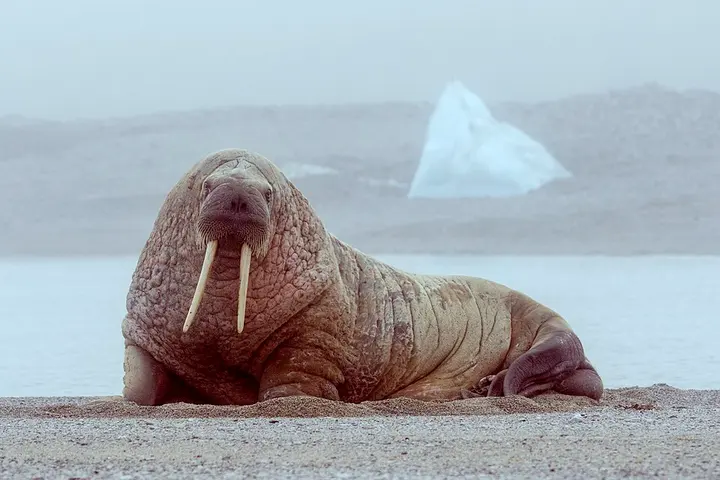
The walrus is a large pinniped marine mammal with discontinuous distribution about the North Pole in the Arctic Ocean and subarctic seas of the Northern Hemisphere. It is the only extant species in the family Odobenidae and genus Odobenus. This species is subdivided into two subspecies: the Atlantic walrus, which lives in the Atlantic Ocean, and the Pacific walrus, which lives in the Pacific Ocean.
Adult walrus are characterised by prominent tusks and whiskers, and considerable bulk; adult males in the Pacific can weigh more than 2,000 kilograms (4,400 pounds) and, among pinnipeds, are exceeded in size only by the two species of elephant seals. Walrus live mostly in shallow waters above the continental shelves, spending significant amounts of their lives on the sea ice looking for benthic bivalve molluscs. Walruses are relatively long-lived, social and intelligent animals, and are considered a keystone species of the Arctic marine region. The walrus has played a prominent role in the cultures of many indigenous Arctic peoples, who have hunted it for meat, fat, skin, tusks, and bone.
Appearance
While some outsized Pacific males can weigh as much as 2,000 kg (4,400 lb), most weigh between 800 and 1,700 kg (1,800 and 3,700 lb). An occasional male of the Pacific subspecies far exceeds normal dimensions. In 1909, a walrus hide weighing 500 kg (1,100 lb) was collected from an enormous bull in Franz Josef Land, while in August 1910, Jack Woodson shot a 4.9-metre-long (16 ft) walrus, harvesting its 450 kg (1,000 lb) hide.
Behaviour
The majority of the population of the Pacific walrus spends its summers north of the Bering Strait in the Chukchi Sea of the Arctic Ocean along the northern coast of eastern Siberia, around Wrangel Island, in the Beaufort Sea along the northern shore of Alaska south to Unimak Island, and in the waters between those locations.
Diet
Walruses prefer shallow shelf regions and forage primarily on the sea floor, often from sea ice platforms. They are not particularly deep divers compared to other pinnipeds; the deepest dives in a study of Atlantic walrus near Svalbard were only 31 ± 17 m (102 ± 56 ft).
Life cycle
Walruses live to about 20–30 years old in the wild. The oldest-living walrus on record was Slowpoke, a captive walrus at SeaWorld Orlando, who lived to be 49 years old when he died. The males reach sexual maturity as early as 7 years, but do not typically mate until fully developed at around 15 years of age. They rut from January through April, decreasing their food intake dramatically. The females begin ovulating as soon as 4-6 years old.
Where the Walrus lives
Recorded in United States of America, Russia and Netherlands (North America, Europe and Asia).
Most records fall in Alaska, Chukchi Autonomous Okrug, Friesland, Noord-Holland and Zeeland.
See the Walrus’s range on the globe
Conservation status
Vulnerable (VU). At risk: it could become endangered. Categories are the IUCN Red List as republished by GBIF.
Sources
The range is a density of 24,470 georeferenced GBIF records, shown on the continents where it is mainly recorded, not an expert-drawn map. Description from Wikipedia.