Animals / Mammal
Virginia opossum
Didelphis virginiana · Didelphidae
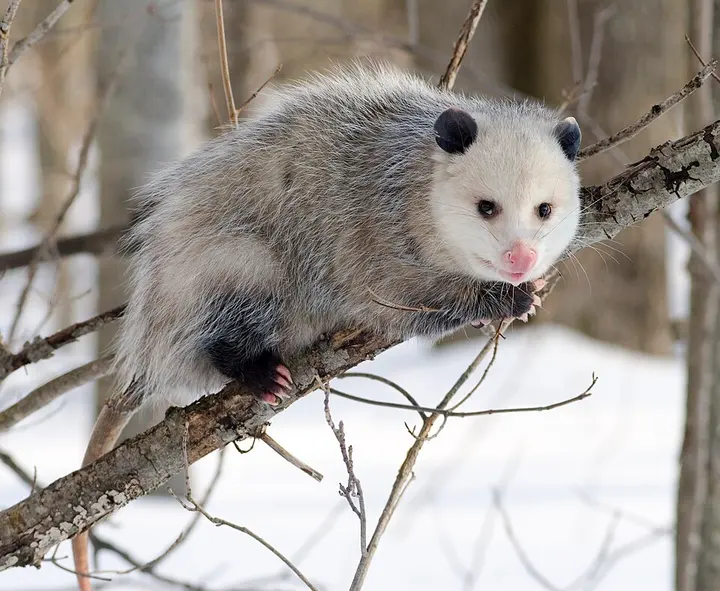
The Virginia opossum, also known as the North American opossum, is a member of the opossum family found from southern Canada to northern Costa Rica, making it the northernmost marsupial in the world. Commonly referred to simply as the possum, it is a solitary nocturnal animal about the size of a domestic cat, and a successful opportunist.
Opossums are familiar to many North Americans as they frequently inhabit settled areas near food sources like trash cans, pet food, compost piles, gardens or housemice. Their slow, nocturnal nature and their attraction to roadside carrion make opossums more likely to become roadkill than other animals in their range.
Appearance
Virginia opossums can vary considerably in size, with larger specimens found to the north of the opossum's range and smaller specimens in the tropics. They measure 33–55 cm (13–22 in) long from their snout to the base of the tail, with the tail adding another 25–54 cm (9.8–21.3 in).
Behaviour
If threatened, an opossum will either flee or take a stand. To appear threatening, an opossum will first bare its 50 teeth, snap its jaw, hiss, drool, and stand its fur on end to look bigger. If this does not work, the Virginia opossum is noted for feigning death in response to extreme fear. This is the genesis of the term "playing possum", which means pretending to be dead or injured with intent to deceive.
Diet
Opossums are omnivorous and eat a wide range of plant-based food, as well as animal-based food like small invertebrates, carrion, eggs, fish, amphibians, reptiles, birds, small mammals, and other small animals. Insects such as grasshoppers, crickets, and beetles make up the bulk of the animal foods eaten by opossums.
Habitat
The Virginia opossum's ancestors evolved in South America, but spread into North America as part of the Great American Interchange, which occurred mainly after the formation of the Isthmus of Panama about 3 million years ago. Didelphis was apparently one of the later migrants, entering North America about 0.8 million years ago.
Life cycle
The breeding season for the Virginia opossum can begin as early as December and continue through October with most young born between February and June. A female opossum may have one to three litters per year. During the mating season, the male attracts the female by making clicking sounds with his mouth. The female's estrus cycle is 28 days and lasts 36 hours. Gestation lasts 11–13 days and the average litter size is 8–9 infants, although over 20 infants may be born.
Where the Virginia opossum lives
Recorded in United States of America, Mexico and Canada (North America).
Most records fall in Texas, California, Florida, North Carolina, Illinois and Ontario.
See the Virginia opossum’s range on the globe
Conservation status
Least concern (LC). Not at risk: it is doing well in the wild. Categories are the IUCN Red List as republished by GBIF.
Sources
The range is a density of 61,011 georeferenced GBIF records, shown on the continents where it is mainly recorded, not an expert-drawn map. Description from Wikipedia.