Animals / Mammal
Vicuña
Vicugna vicugna · Camelidae
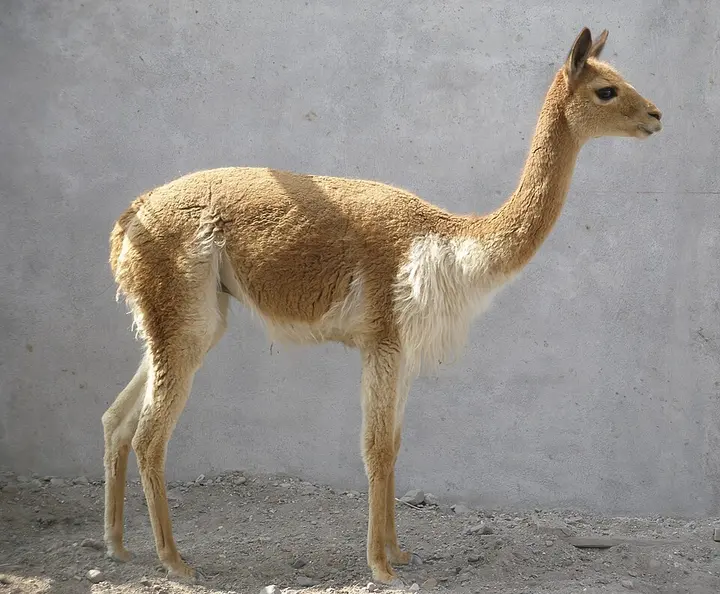
The vicuña or vicuna is a wild South American camelid which lives in high alpine areas of the Andes. It is a relative of the llama, the domesticated descendant of the guanaco, the only other still wild South American camelid.
The vicuña is believed to be the ancestor of domesticated alpaca, which is raised for its coat. The vicuña produces small amounts of extremely fine wool, which is very expensive because the animal has to be caught from the wild to be fleeced and can only be shorn every three years. When knitted together, the product of the vicuña's wool is very soft and warm. The Inca valued the vicuña highly for its wool, and it was prohibited for anyone but royalty to wear vicuña garments; today, the vicuña is the national animal of Peru and appears on the Peruvian coat of arms. Both under the rule of the Inca and today, the vicuña has been protected by law, but it was heavily hunted in the intervening period. Only about 6,000 animals were left when it was declared endangered in 1974.
Appearance
The vicuña is smaller, more delicate, and considered gracile than the guanaco. A key distinguishing element of morphology is the better-developed incisor roots for the guanaco. The vicuña's long, woolly coat is tawny brown on the back, whereas the hair on the throat and chest is white and quite long. Its head is slightly shorter than guanaco's, and the ears are slightly longer.
Behaviour
The behavior of vicuñas is similar to that of the guanacos. They are timid animals and are easily aroused by intruders due, among other things, to their extraordinary hearing. Like the guanacos, they frequently lick calcareous stones and rocks, which, together with salt water, is its source of salt. Vicuñas are clean animals and always deposit their excrement in the same place. Their diets consist mainly of low grasses which grow in clumps on the ground.
Habitat
Currently, vicuñas are restricted to South America's central Andes. They are found in Peru, northwestern Argentina, Bolivia, and northern Chile. A smaller, introduced population lives in central Ecuador. However, fossil remains indicate that they were also found as far as Uruguay and the Straits of Magellan until the early Holocene, together with the related guanaco. Vicuñas live at altitudes of 3,200 to 4,800 m (10,500–15,700 ft).
Where the Vicuña lives
Recorded in Chile, Argentina, Peru, Bolivia and Ecuador (South America).
Most records fall in Antofagasta, Jujuy, Potosí, Arequipa, Tarapacá and Arica y Parinacota.
See the Vicuña’s range on the globe
Conservation status
Least concern (LC). Not at risk: it is doing well in the wild. Categories are the IUCN Red List as republished by GBIF.
Sources
The range is a density of 2,972 georeferenced GBIF records, shown on the continents where it is mainly recorded, not an expert-drawn map. Description from Wikipedia.