Animals / Bird
Turkey vulture
Cathartes aura · Cathartidae
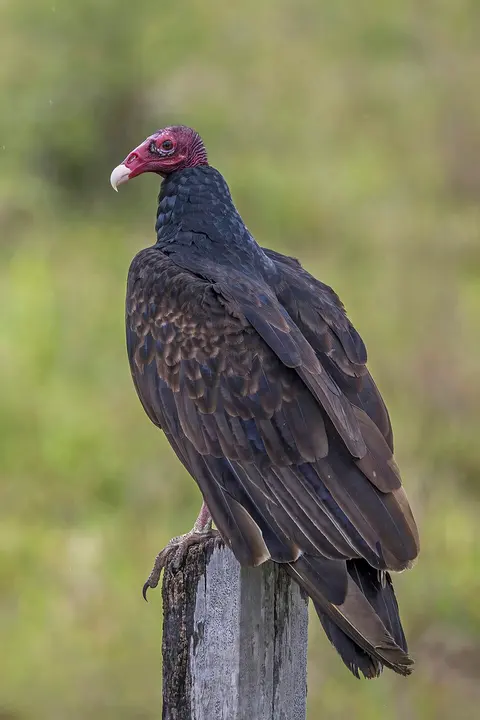
The turkey vulture is the most widespread of the New World vultures. One of three species in the genus Cathartes of the family Cathartidae, the turkey vulture ranges from southern Canada to the southernmost tip of South America. It inhabits a variety of open and semi-open areas, including subtropical forests, shrublands, pastures, and deserts.
Like all New World vultures, it is not closely related to the Old World vultures of Europe, Africa, and Asia. However, the two groups strongly resemble each other due to convergent evolution. The turkey vulture is a scavenger and feeds almost exclusively on carrion. It finds its food using its keen eyes and sense of smell, flying low enough to detect the gasses produced by the early stages of decay in dead animals. In flight, it uses thermals to move through the air, flapping its wings infrequently. It roosts in large community groups. Lacking a syrinx—the vocal organ of birds—its only vocalizations are grunts or low hisses. It nests in caves, hollow trees, or thickets. Each year it generally raises two chicks, which it feeds by regurgitation. It has very few natural predators.
Appearance
A large bird, it has a wingspan of 1.5–2 m (4.9–6.6 ft) a length of 62–81 cm (24–32 in), and weight of 0.8 to 2.41 kg (1.8 to 5.3 lb). Birds in the northern limit of the species' range average larger in size than the vulture from the neotropics. 124 birds from Florida averaged 2 kg (4.4 lb) while 65 and 130 birds from Venezuela were found to average 1.22 and 1.45 kg (2.7 and 3.2 lb), respectively.
Behaviour
The turkey vulture is gregarious and roosts in large community groups, breaking away to forage independently during the day. Several hundred vultures may roost communally in groups, which sometimes even include black vultures. It roosts often on dead, leafless trees as well as low-density conifers, and will also roost on man-made structures such as water or microwave towers. Though it nests in caves, it does not enter them except during the breeding season.
Diet
The turkey vulture feeds primarily on a wide variety of carrion, from small mammals (such as mice and shrews) to large grazers (such as ungulates), preferring those recently dead, and avoiding carcasses that have reached the point of putrefaction. They may rarely feed on plant matter, shoreline vegetation, pumpkin, grape, juniper, coconut and other crops, live frogs, live insects and other invertebrates.
Habitat
The turkey vulture has a large range, with an estimated global occurrence of 28,000,000 km2 (11,000,000 sq mi). It is the most widely distributed vulture in the Americas and rivals its cousin the black vulture as the most abundant raptorial bird worldwide. Its global population is estimated to be 18,000,000 individuals. It is found in open and semi-open areas throughout the Americas from southern Canada to Cape Horn.
Where the Turkey vulture lives
Recorded in United States of America, Canada, Mexico and Costa Rica (North America).
Most records fall in California, Texas, Florida, Pennsylvania, Ontario and Virginia.
See the Turkey vulture’s range on the globe
Conservation status
Least concern (LC). Not at risk: it is doing well in the wild. Categories are the IUCN Red List as republished by GBIF.
Sources
The range is a density of 17,650,625 georeferenced GBIF records, shown on the continents where it is mainly recorded, not an expert-drawn map. Description from Wikipedia.