Animals / Bird
Tufted titmouse
Baeolophus bicolor · Paridae
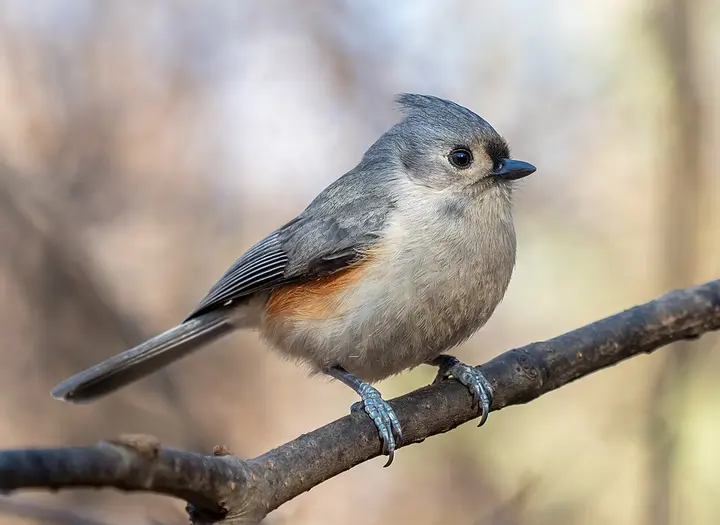
The tufted titmouse is a small songbird native to eastern North America. The species belongs to the tit and chickadee family (Paridae). The black-crested titmouse, found from central and southern Texas southward, was originally included as a subspecies but now is considered a separate species, Baeolophus atricristatus.
Appearance
A small bird, the tufted titmouse has a white front and gray upper body outlined with rust-colored flanks. Other characteristics include its black forehead and the tufted gray crest on its head. In juveniles, the black forehead is greatly diminished such that it may be confused with the oak titmouse, although their ranges do not overlap. Males tend to be larger than females.
Behaviour
The tufted titmouse gathers food from the ground and from tree branches, frequently consuming a variety of berries, nuts, seeds, small fruits, and insects and other invertebrates. Caterpillars constitute a major part of its diet during the summer. This species is also a regular visitor to bird feeders. Its normal pattern is to scout a feeder from cover, fly in to take a seed, then fly back to shelter to consume the morsel, though caching is also very common.
Diet
Annually, nearly two-thirds of the tufted titmouse diet consists of insects. During the summer, caterpillars are an essential part of their diet. With respect to nuts and seeds, the tufted titmouse primarily prefers sunflower seeds and consumes suet and peanuts, as well. During the fall and winter, the tufted titmouse hoards food. When visiting a feeder, they take one seed per visit and store seeds within 130 feet of the feeder.
Habitat
The habitat of the tufted titmouse is deciduous and mixed woods, gardens, parks, and shrublands. Although it is nonmigratory and originally native to the Ohio and Mississippi River basins, factors such as bird feeders have caused it to occupy a larger territory across the United States and stretching into Ontario and Quebec in Canada. During the second half of the 20th century and into the 21st century, the species' range has been expanding northwards.
Where the Tufted titmouse lives
Recorded in United States of America (North America).
Most records fall in Pennsylvania, New York, Virginia, Massachusetts, North Carolina and Ohio.
See the Tufted titmouse’s range on the globe
Conservation status
Least concern (LC). Not at risk: it is doing well in the wild. Categories are the IUCN Red List as republished by GBIF.
Sources
The range is a density of 13,300,707 georeferenced GBIF records, shown on the continents where it is mainly recorded, not an expert-drawn map. Description from Wikipedia.