Animals / Mammal
Topi
Damaliscus lunatus · Bovidae
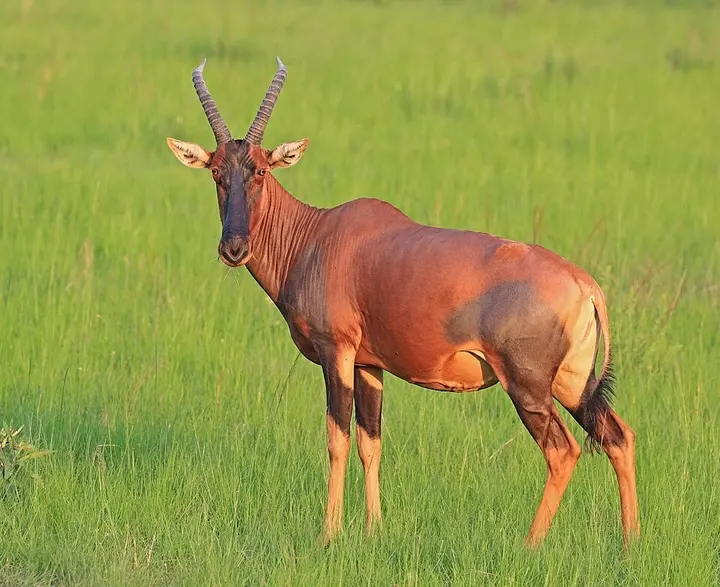
Damaliscus lunatus jimela is a subspecies of topi, and is usually just called a topi. It is a highly social and fast type of antelope found in the savannas, semi-deserts, and floodplains of sub-Saharan Africa.
Appearance
The hair colour of the pelage may vary across the different geographic subpopulations, being darker or lighter (see photos). This subspecies has horns with a shape that gives the effect of the space between them having a lyrate profile when seen from a certain angle, as opposed to lunate, which is seen in the sassaby subspecies found to the south: D. lunatus lunatus and D. lunatus superstes.
Behaviour
Topi prefer pastures with green grass that is medium in height with leaf-like swards. Topis are more densely populated in areas where green plants last into the dry season, particularly near water. When foraging for food, topi tend to take small bites at a fast rate. The topi has what is possibly the most diverse social organization of the antelopes.
Where the Topi lives
Recorded in South Africa, Botswana, Uganda, Benin, Namibia, Kenya, Zambia and Tanzania (Africa).
Most records fall in Limpopo, North-West, Mbarara, North West, Northern Cape and Atakora.
See the Topi’s range on the globe
Conservation status
Least concern (LC). Not at risk: it is doing well in the wild. Categories are the IUCN Red List as republished by GBIF.
Sources
The range is a density of 1,888 georeferenced GBIF records, shown on the continents where it is mainly recorded, not an expert-drawn map. Description from Wikipedia.