Animals / Reptile
Tokay gecko
Gekko gecko · Gekkonidae
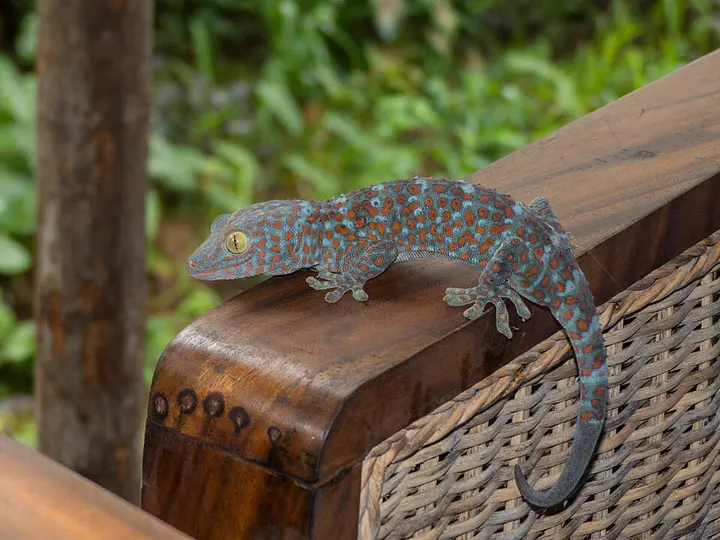
The tokay gecko is a nocturnal arboreal gecko in the genus Gekko, the true geckos. It is native to Asia and some Pacific Islands.
Appearance
The tokay gecko is a large nocturnal gecko, reaching a total length (including tail) of 25–30 cm (10–12 inches) on average, but some grow as large as 40 cm (16 inches) long. It is believed to be the third-largest species of gecko, after the giant leaf-tail gecko (Uroplatus giganteus) and New Caledonian giant gecko (Rhacodactylus leachianus). It is cylindrical, but somewhat flattened in body shape. The eyes have vertical pupils.
Behaviour
Tokay geckos are generally aggressive and territorial, and can inflict a strong bite. Though common in the pet trade, the strong bite of the tokay gecko makes it ill-suited for inexperienced keepers. In addition, the strength of the bite depends on the gecko's size; larger (usually male) tokay geckos are capable of piercing skin, which often results in immediate bleeding. Females lay clutches of one or two hard-shelled eggs and guard them until they hatch.
Diet
The tokay gecko feeds on insects and small vertebrates. In captivity, they usually feed on springtails, mealworms, cockroaches, crickets, grasshoppers, locusts, and pink mice. In a study conducted in Thailand, researchers noticed little variation in the diets of males, females, and juveniles, which was likely due to low insect availability in this area.
Habitat
This species is found in northeast India, Bhutan, Nepal, and Bangladesh; throughout Southeast Asia, including Cambodia, Thailand, the Philippines, Malaysia, Vietnam and Indonesia; and toward western New Guinea. Its native habitat is rainforests, where it lives on trees and cliffs, and it frequently adapts to rural human habitations, roaming walls and ceilings at night in search of insect prey. This is an introduced species in some areas outside its native range.
Where the Tokay gecko lives
Recorded in Indonesia, Thailand, Philippines, United States of America, Vietnam, Cambodia and Malaysia (Asia and North America).
Most records fall in Bali, Jawa Barat, Jawa Tengah, Florida, Nusa Tenggara Timur and Banten.
See the Tokay gecko’s range on the globe
Conservation status
Least concern (LC). Not at risk: it is doing well in the wild. Categories are the IUCN Red List as republished by GBIF.
Sources
The range is a density of 12,644 georeferenced GBIF records, shown on the continents where it is mainly recorded, not an expert-drawn map. Description from Wikipedia.