Animals / Mammal
Tiger
Panthera tigris · Felidae
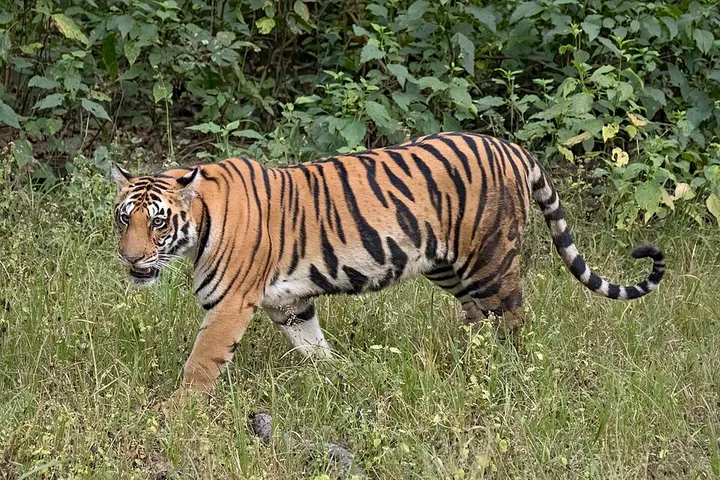
The tiger is a large cat and a member of the genus Panthera native to Asia. It has a powerful, muscular body with a large head and paws, a long tail and orange fur that fades to white in parts, with black, mostly vertical stripes. It is traditionally classified into nine subspecies, though some recognise only two subspecies, the mainland Asian tiger and the Sunda Islands tiger.
Throughout its range, it inhabits mainly forests, from coniferous and temperate broadleaf and mixed forests in the Russian Far East and Northeast China to tropical and subtropical moist broadleaf forests on the Indian subcontinent and Southeast Asia. The tiger is an apex predator and preys mainly on hooved mammals, which it takes by ambush. It lives a mostly solitary life and occupies home ranges, defending these from individuals of the same sex. The range of a male tiger overlaps with that of multiple females with whom he mates. Females give birth to usually two or three cubs that stay with their mother for about two years. When becoming independent, they leave their mother's home range and establish their own.
Appearance
The tiger has a typical felid morphology, with a muscular body, shortened legs, strong forelimbs with wide front paws, a large head and a tail that is about half the length of the rest of its body. It has five digits, including a dewclaw, on the front feet and four on the back, all of which have retractile claws that are compact and curved, and can reach 10 cm (3.9 in) long. The ears are rounded and the eyes have a round pupil.
Behaviour
Camera trap data show that tigers in Chitwan National Park avoided locations frequented by people and were more active at night than during day. In Sundarbans National Park, six radio-collared tigers were most active from dawn to early morning and reached their zenith around 7:00 o'clock in the morning. A three-year-long camera trap survey in Shuklaphanta National Park revealed that tigers were most active from dusk until midnight.
Diet
Tigers have been hunted by humans for millennia, as indicated by a painting on the Bhimbetka rock shelters in India that is dated to 5,000–6,000 years ago. They were hunted throughout their range in Asia, chased on horseback, elephant-back or even with sled dogs and killed with spears and later firearms. Such hunts were conducted both by Asian governments and empires like the Mughal Empire, as well as European colonists.
Habitat
The tiger historically ranged from eastern Turkey, northern Iran and Afghanistan to Central Asia and from northern Pakistan through the Indian subcontinent and Indochina to southeastern Siberia, Sumatra, Java and Bali. As of 2022, it inhabits less than 7% of its historical distribution and has a scattered range in the Indian subcontinent, the Indochinese Peninsula, Sumatra, northeastern China and the Russian Far East.
Where the Tiger lives
Recorded in India, Russia and Nepal (Asia).
Most records fall in Madhya Pradesh, Maharashtra, Rajasthan, Uttarakhand, Karnataka and West Bengal.
See the Tiger’s range on the globe
Conservation status
Endangered (EN). In danger of dying out in the wild. Categories are the IUCN Red List as republished by GBIF.
Sources
The range is a density of 5,349 georeferenced GBIF records, shown on the continents where it is mainly recorded, not an expert-drawn map. Description from Wikipedia.