Animals / Bird
Tawny owl
Strix aluco · Strigidae
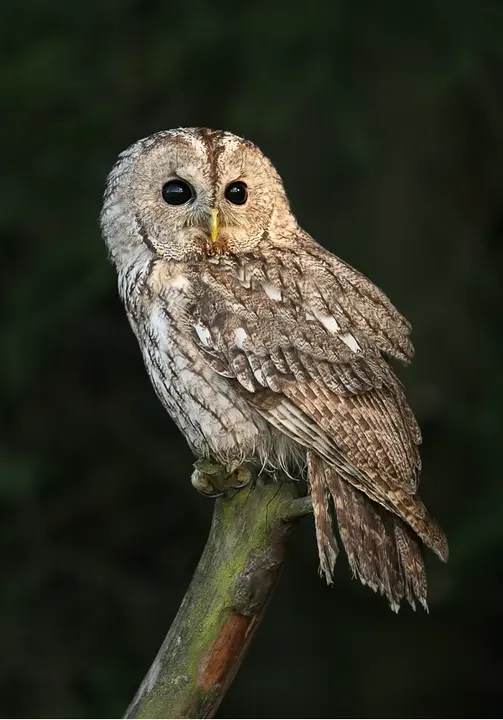
The tawny owl, also called the brown owl, is a stocky, medium-sized owl in the family Strigidae. It is commonly found in woodlands across Europe, as well as western Siberia, and has seven recognized subspecies. The tawny owl's underparts are pale with dark streaks, whilst its upper body may be either brown or grey.
The tawny owl typically makes its nest in a tree hole where it can protect its eggs and young against potential predators. It is non-migratory and highly territorial: as a result, when young birds grow up and leave the parental nest, if they cannot find a vacant territory to claim as their own, they will often starve. The tawny owl is a nocturnal bird of prey. It is able to hunt successfully at night because of its vision, hearing adaptations and ability to fly silently. It usually hunts by dropping suddenly from a perch and seizing its prey, which it swallows whole. Its typical prey are rodents, although in urbanised areas its diet includes a higher proportion of birds. It also sometimes catches smaller owls, and is itself sometimes hunted by the eagle owl and the Eurasian goshawk.
Appearance
The tawny owl is a robust bird, 37–46 cm (15–18 in) in length, with an 81–105 cm (32–41 in) wingspan. Weight can range from 385 to 800 g (0.849 to 1.764 lb). Its large rounded head lacks ear tufts, and the facial disc surrounding the dark brown eyes is usually rather plain. The nominate race has two morphs which differ in their plumage colour, one form having rufous brown upperparts and the other greyish brown, although intermediates also occur.
Behaviour
Tawny owls pair off from the age of one year, and stay together in a usually monogamous relationship for life. An established pair's territory is defended year-round and maintained with little, if any, boundary change from year to year. The pair sit in cover on a branch close to a tree trunk during the day, and usually roost separately from July to October. Roosting owls may be discovered and "mobbed" by small birds during the day, but they normally ignore the disturbance.
Diet
The tawny owl hunts almost entirely at night, watching from a perch before dropping or gliding silently down to its victim, but very occasionally it will hunt in daylight when it has young to feed. This species takes a wide range of prey, mainly woodland rodents, but also other mammals up to the size of a young rabbit, and birds, earthworms and beetles.
Habitat
The tawny owl is non-migratory and has a distribution stretching discontinuously across temperate Europe, from Great Britain and the Iberian Peninsula eastwards to western Siberia. It is absent from Ireland - probably because of competition from the long-eared owl (Asio otus) - and only a rare vagrant to the Balearic and Canary Islands. In the Himalayas and East Asia it is replaced by the Himalayan owl (S. nivicolum).
Where the Tawny owl lives
Recorded in Sweden, France, Finland, United Kingdom, Denmark, Norway, Netherlands, Belgium, Spain, Germany and Portugal (Europe).
Most records fall in Västra Götaland, Stockholm, Pirkanmaa, Uusimaa, Uppsala and Skåne.
See the Tawny owl’s range on the globe
Conservation status
Least concern (LC). Not at risk: it is doing well in the wild. Categories are the IUCN Red List as republished by GBIF.
Sources
The range is a density of 1,014,080 georeferenced GBIF records, shown on the continents where it is mainly recorded, not an expert-drawn map. Description from Wikipedia.