Animals / Mammal
Tasmanian devil
Sarcophilus harrisii · Dasyuridae
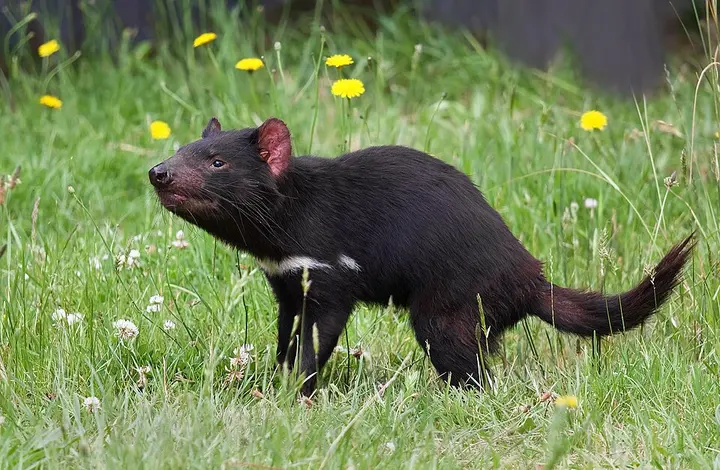
The Tasmanian devil is a carnivorous marsupial of the family Dasyuridae. It was formerly present across mainland Australia, but became extinct there around 3,500 years ago; it is now confined to the island of Tasmania. The size of a small dog, the Tasmanian devil became the largest carnivorous marsupial in the world following the extinction of the thylacine in 1936.
It is related to quolls, and distantly related to the thylacine. It is characterised by its stocky and muscular build, black fur, pungent odour, extremely loud screech, keen sense of smell, and ferocity when feeding. The Tasmanian devil's large head and neck allow it to generate among the strongest bites per unit body mass of any extant predatory land mammal. It hunts prey and scavenges on carrion. Although devils are usually solitary, they sometimes eat and defecate together in a communal location. Unlike most other dasyurids, the devil thermoregulates effectively, and is active during the middle of the day without overheating. Despite its rotund appearance, it is capable of surprising speed and endurance, and can climb trees and swim across rivers. Devils are not monogamous.
Appearance
The Tasmanian devil is the largest surviving carnivorous marsupial. It has a squat, thick build, with a large head and a tail which is about half its body length. Unusually for a marsupial, its forelegs are slightly longer than its hind legs, and devils can run up to 13 km/h (8.1 mph) for short distances, on typical terrain, though on flat roads they have been recorded reaching speeds of up to 25 km/h (16 mph) for distances up to 1.5 km (0.93 mi)..
Behaviour
The Tasmanian devil is a keystone species in the ecosystem of Tasmania. It is a nocturnal and crepuscular hunter, spending the days in dense bush or in a hole. It has been speculated that nocturnalism may have been adopted to avoid predation by eagles and humans. Young devils are predominantly crepuscular. There is no evidence of torpor. Young devils can climb trees, but this becomes more difficult as they grow larger.
Diet
Tasmanian devils can take prey up to the size of a small kangaroo, but in practice they are opportunistic and eat carrion more often than they hunt live prey. Although the devil favours wombats because of the ease of predation and high fat content, it will eat all small native mammals such as wallabies, bettong and potoroos, domestic mammals (including sheep and rabbits), birds (including penguins), fish, fruit, vegetable matter, insects, tadpoles, frogs and reptiles.
Habitat
The Tasmanian devil was formerly present across mainland Australia, but became extinct there 3,500 years ago, co-incident with the extinction of the thylacine from the region. A number of causal factors for the extinction have been proposed, including the introduction of the dingo, intensification of human activity, as well as climatic change.
Where the Tasmanian devil lives
Recorded in Ashmore and Cartier Is. (Oceania).
Most records fall in Tasmania.
See the Tasmanian devil’s range on the globe
Conservation status
Endangered (EN). In danger of dying out in the wild. Categories are the IUCN Red List as republished by GBIF.
Sources
The range is a density of 25,520 georeferenced GBIF records, shown on the continents where it is mainly recorded, not an expert-drawn map. Description from Wikipedia.