Animals / Mammal
Sunda pangolin
Manis javanica · Manidae
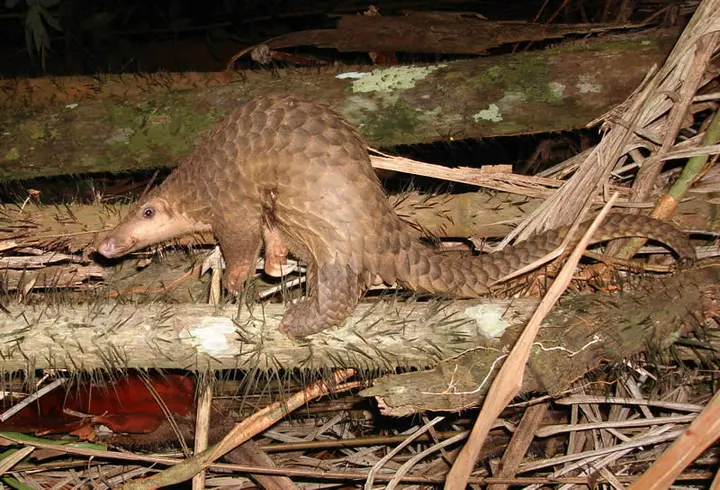
The Sunda pangolin, also known as the Malayan or Javan pangolin, is a species of pangolin. It is a member of the Manidae family. Its English name comes from the Malay name pëngulin, which means "roller".
It is native to Southeast Asia, including Myanmar, Thailand, Cambodia, Laos, Malaysia, Singapore, Vietnam, and the islands of Borneo, Java, Sumatra and the Lesser Sunda Islands. It prefers forested primary, secondary and scrub forest habitats, but also lives in rubber and palm oil plantations. It is largely arboreal.
Appearance
The skin of the Sunda pangolin's feet is granular, although pads are found on its front feet. It has thick and powerful claws to dig into the soils in search of ant nests or to tear into termite mounds. The Sunda pangolin has poor eyesight, but a highly developed sense of smell. Lacking teeth, its long, sticky tongue serves to collect ants and termites.
Behaviour
Pangolins give birth annually to one or two offspring. They breed in the autumn, and females give birth in the winter burrow. Den preference has been known to shift at this time to favor mature forest tree hollows. Presumably, these hollows offer more fortification and stability for the decreased mobility that comes with birthing and caring for young. The amount of time the mother will spend at any one of these dens will increase during parental care periods.
Where the Sunda pangolin lives
Recorded in Singapore, Indonesia, Malaysia, Thailand, Myanmar, Vietnam, Cambodia, Philippines and Laos (Asia).
Most records fall in Sabah, South West, Central Singapore, Sumatera Utara, South East and Sarawak.
See the Sunda pangolin’s range on the globe
Conservation status
Critically endangered (CR). In very great danger of dying out in the wild. Categories are the IUCN Red List as republished by GBIF.
Sources
The range is a density of 244 georeferenced GBIF records, shown on the continents where it is mainly recorded, not an expert-drawn map. Description from Wikipedia.