Animals / Mammal
Sun bear
Helarctos malayanus · Ursidae
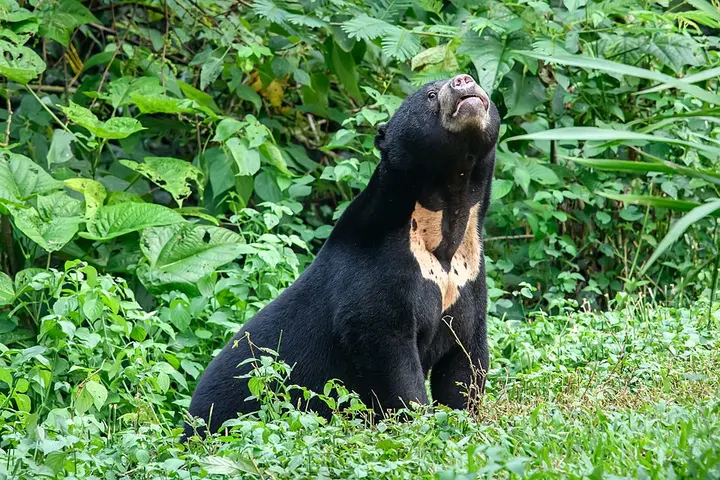
The sun bear is a bear species in the family Ursidae found in the tropical forests of Southeast Asia. It is the only species in the genus Helarctos and the smallest bear species, standing nearly 70 cm (28 in) at the shoulder and weighing 25–65 kg (55–143 lb). It is stockily built, with large paws, strongly curved claws, small, rounded ears and a short snout.
The fur is generally short and jet black, but can vary from grey to red. The sun bear gets its name from its characteristic orange to cream-coloured chest patch. The sun bear's unique morphology with inward-turned front feet, flattened chest, powerful forelimbs with large claws suggests adaptations for climbing, and it is an excellent climber and the most arboreal of all bears. It sunbathes or sleeps in trees 2 to 7 m (6 ft 7 in to 23 ft 0 in) above the ground. It is mainly active during the day, though nocturnality might be more common in areas frequented by humans. It tends to remain solitary, but sometimes occur in pairs such as a mother and her cub. It does not hibernate, possibly because food resources are available the whole year throughout its range.
Appearance
The sun bear is named so for its characteristic orange- to cream-coloured, crescent-like chest patch. It is the smallest of all bear species. It is stockily built, with large paws, strongly curved claws, small rounded ears and a short snout. The head-and-body length is between 100 and 140 cm (39 and 55 in), and the shoulder height is nearly 70 cm (28 in). Males tend to be larger than females by roughly 10-20%. Adults weigh 25–65 kg (55–143 lb).
Behaviour
The sun bear leads a particularly arboreal lifestyle among bears. It is a capable climber; it sunbathes or sleeps in trees 2 to 7 m (6 ft 7 in to 23 ft 0 in) above the ground. Bedding sites consist mainly of fallen hollow logs, but they also rest in standing trees with cavities, underneath fallen logs or tree roots, and in tree branches high above the ground. It is also an efficient swimmer. The sun bear is solitary but is sometimes seen in pairs such as mothers and cubs.
Diet
The sun bear is an omnivore with a broad diet, such as ants, bees, beetles, honey, termites, and plant material such as seeds and several kinds of fruits. Sun bear scat collected in Ulu Segama Forest Reserve in Sabah also contained remains of the Asian forest tortoise, other reptiles, and of figs and other fruits.
Habitat
The sun bear is native to the tropical forests of Southeast Asia; its range is bound by northeastern India to the north and extends south to Bangladesh, Myanmar, Thailand, Cambodia, Laos, and Vietnam to Brunei, Indonesia, and Malaysia to the south. Its presence in China was confirmed in 2017 when it was sighted in Yingjiang County of Yunnan Province. It is extinct in Singapore.
Where the Sun bear lives
Recorded in Thailand, Indonesia, Malaysia and Cambodia (Asia).
Most records fall in Phetchaburi, Sabah, Kalimantan Tengah, Riau, Perak and Pahang.
See the Sun bear’s range on the globe
Conservation status
Vulnerable (VU). At risk: it could become endangered. Categories are the IUCN Red List as republished by GBIF.
Sources
The range is a density of 466 georeferenced GBIF records, shown on the continents where it is mainly recorded, not an expert-drawn map. Description from Wikipedia.