Animals / Bird
Sulphur-crested cockatoo
Cacatua galerita · Psittacidae
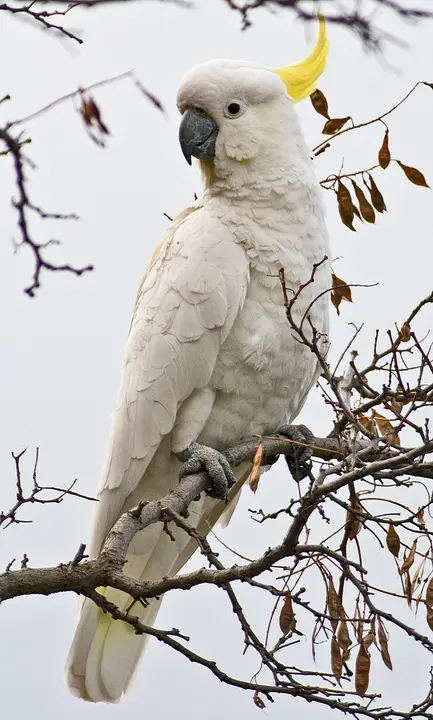
The sulphur-crested cockatoo is a relatively large white cockatoo found in wooded habitats in Australia, New Guinea, and some of the islands of Indonesia. They can be locally very numerous, leading to them sometimes being considered pests. As highly intelligent birds, they are well known in aviculture, although they can be demanding pets.
Appearance
Sulphur-crested cockatoos are 44–55 cm (17.5–21.5 in) long, with the Australian subspecies larger than subspecies from New Guinea and nearby islands. Their plumage is overall white, while the underwing and -tail are tinged yellow. The expressive crest is yellow. The bill is black, the legs are grey, and the eye-ring is whitish. Males typically have almost black eyes, whereas the females have more red or brown eyes, but this requires optimum viewing conditions to be seen.
Behaviour
Sulphur-crested cockatoos' distinctive, raucous calls can be very loud, which is a result of an adaptation to travel through the forest environments in which they live, including tropical and subtropical rainforests. These birds are naturally curious, as well as very intelligent. They have adapted very well to European settlement in Australia and live in many urban areas. Being intelligent, in Sydney, Australia, they have learned how to open garbage bins as a source of food.
Habitat
The species is native to large parts of Australia, Indonesia, and Papua New Guinea. Within Australia, sulphur-crested cockatoos of the nominate race have also been introduced to Perth, which is far outside their natural range. Outside Australia, they have been introduced to Singapore, where their numbers have been estimated to be between 500 and 2000. They have also been introduced to Palau and New Zealand.
Where the Sulphur-crested cockatoo lives
Recorded in Ashmore and Cartier Is. (Oceania).
Most records fall in New South Wales, Victoria, Queensland, Australian Capital Territory, Northern Territory and South Australia.
See the Sulphur-crested cockatoo’s range on the globe
Conservation status
Least concern (LC). Not at risk: it is doing well in the wild. Categories are the IUCN Red List as republished by GBIF.
Sources
The range is a density of 1,314,175 georeferenced GBIF records, shown on the continents where it is mainly recorded, not an expert-drawn map. Description from Wikipedia.