Animals / Mammal
Striped skunk
Mephitis mephitis · Mephitidae
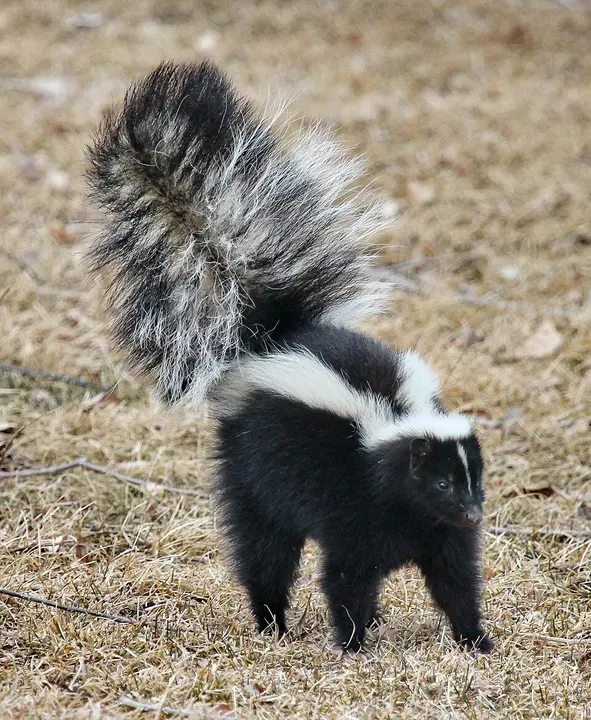
The striped skunk is a skunk of the genus Mephitis that occurs across much of North America, including southern Canada, the United States, and northern Mexico. It is currently listed as least concern by the IUCN on account of its wide range and ability to adapt to human-modified environments.
Striped skunks are polygamous omnivores with few natural predators, save for birds of prey. Striped skunks are mostly nocturnal. Like all skunks, they possess highly developed musk-filled scent glands to ward off predators. They have a long history of association with humans, having been trapped and captively bred for their fur and kept as pets. The striped skunk is one of the most recognizable of North America's animals, and is a popular figure in cartoons and children's books.
Appearance
The striped skunk is a stoutly-built, short-limbed animal with a small, conical head and a long, heavily furred tail. Adult males are 10% larger than females, with both sexes measuring between 52–77 centimetres (20–30 in) in total body length and usually weighing 1.8–4.5 kg (4.0–9.9 lb), though some may weigh 5.5 kg (12 lb). The feet are plantigrade with bare soles, and are not as broad or flat as those of hog-nosed skunks.
Behaviour
The striped skunk inhabits a wide variety of habitats, particularly mixed woodlands, brushy corners and open fields interspersed with wooded ravines and rocky outcrops. Some populations, particularly in northwestern Illinois, prefer cultivated areas over uncultivated ones.
Diet
While primarily an insectivore, the striped skunk is adaptable enough to incorporate other animals and even vegetable matter into its diet. The most frequently consumed insects include grasshoppers, beetles, crickets, caterpillars, other insect larvae and bees. Other invertebrates may include worms, crayfish and other non-insect arthropods.
Habitat
The striped skunk inhabits a wide variety of habitats, particularly mixed woodlands, brushy corners and open fields interspersed with wooded ravines and rocky outcrops. Some populations, particularly in northwestern Illinois, prefer cultivated areas over uncultivated ones.
Life cycle
The striped skunk is polygamous, and normally breeds once a year, though yearling females who have failed to mate may enter a second estrous cycle a month after the first. The mating season usually occurs between mid-February to mid-April, though it is delayed at higher latitudes. Prior to copulating, the males' testicles swell during the January–February period, with maximum size being attained in March.
Where the Striped skunk lives
Recorded in United States of America and Canada (North America).
Most records fall in California, Texas, Ontario, New York, Arkansas and Ohio.
See the Striped skunk’s range on the globe
Conservation status
Least concern (LC). Not at risk: it is doing well in the wild. Categories are the IUCN Red List as republished by GBIF.
Sources
The range is a density of 39,988 georeferenced GBIF records, shown on the continents where it is mainly recorded, not an expert-drawn map. Description from Wikipedia.