Animals / Mammal
Striped hyena
Hyaena hyaena · Hyaenidae
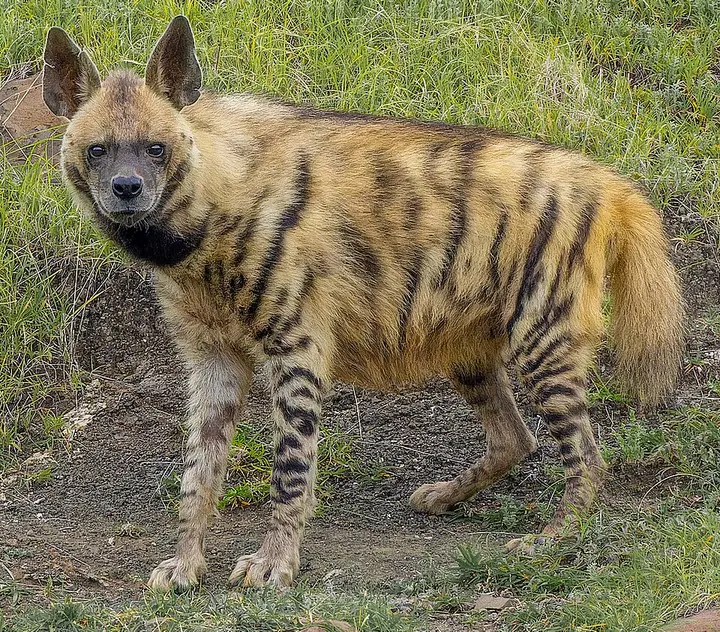
The striped hyena is a species of hyena native to North and East Africa, the Middle East, the Caucasus, Central Asia, and the Indian subcontinent. It is the only extant species in the genus Hyaena. It is listed on the IUCN Red List as near-threatened, as the global population is estimated to be under 10,000 mature individuals which continues to experience deliberate and incidental persecution along with a decrease in its prey base such that it may come close to meeting a continuing decline of 10% over the next three generations.
It is the smallest of the bone-cracking hyenas and retains many primitive viverrid-like characteristics lost in larger species, having a smaller and less specialised skull. Though primarily a scavenger, large specimens have been known to kill their own prey, and attacks on humans have occurred in rare instances. The striped hyena is a monogamous animal, with both males and females assisting one another in raising their cubs. A nocturnal animal, the striped hyena typically only emerges in complete darkness, and is quick to return to its lair before sunrise. Although it has a habit of feigning death when attacked, it has been known to stand its ground against larger predators in disputes over food. The striped hyena features prominently in Middle Eastern and Asian folklore.
Appearance
The striped hyena has a fairly massive, but short torso set on long legs. The hind legs are significantly shorter than the forelimbs; the back slopes down towards the tail. The legs are relatively thin and weak, with the forelegs being bent at the carpal region. The neck is thick, long and largely immobile, while the head is heavy and massive with a shortened facial region. The eyes are small, while the sharply pointed ears are very large, broad and set high on the head.
Behaviour
The striped hyena is a primarily nocturnal animal, which typically only leaves its den at the onset of total darkness, returning before sunrise. Striped hyenas typically live alone or in pairs, though groups of up to seven animals are known in Libya. They are generally not territorial, with home ranges of different groups often overlapping each other.
Diet
The striped hyena is primarily a scavenger which feeds mainly on ungulate (such as zebra, wildebeest, gazelle and impala) carcasses in different stages of decomposition, fresh bones, cartilages, ligaments, and bone marrow. It crushes long bones into fine particles and swallows them, though sometimes entire bones are eaten whole. The striped hyena is not a fussy eater, though it has an aversion to vulture flesh.
Habitat
The striped hyena's historical range encompassed Africa north of and including the Sahel zone, eastern Africa south into Tanzania, the Arabian Peninsula and the Middle East up to the Mediterranean Sea, Turkey, Iraq, the Caucasus (Azerbaijan, Armenia, Georgia), Iran, Turkmenistan, Uzbekistan, Tajikistan, Afghanistan (excluding the higher areas of Hindukush), and the Indian subcontinent.
Where the Striped hyena lives
Recorded in Israel and India (Asia).
Most records fall in HaDarom, Jerusalem, Haifa, HaZafon, HaMerkaz and Gujarat.
See the Striped hyena’s range on the globe
Conservation status
Near threatened (NT). Not at risk yet, but could be soon. Categories are the IUCN Red List as republished by GBIF.
Sources
The range is a density of 8,039 georeferenced GBIF records, shown on the continents where it is mainly recorded, not an expert-drawn map. Description from Wikipedia.