Animals / Mammal
Straw-coloured fruit bat
Eidolon helvum · Pteropodidae
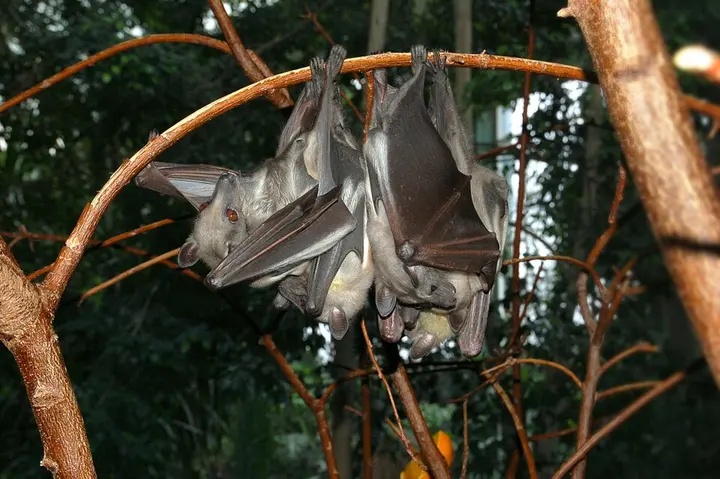
The straw-coloured fruit bat is a large fruit bat that is the most widely distributed of all the African megabats. It is quite common throughout its area ranging from the southwestern Arabian Peninsula, across forest and savanna zones of sub-Saharan Africa. It is listed as Near Threatened on the IUCN Red List due to a decreasing population trend.
Straw-coloured fruit bats travel in massive colonies of at least 100,000 bats and sometimes massing up to 1 million. From October to end of December every year, in the largest migration of mammals on the planet, up to 10 million straw-coloured fruit bats congregate in Kasanka National Park, Zambia, roosting in a 2 hectares (4.9 acres) area of Mushitu forest each day. This migration was only discovered in 1980. Their necks and backs are a yellowish-brown colour, while their undersides are tawny olive or brownish.
Appearance
The straw-coloured fruit bat is named for the silky yellowish or straw colour of its fur. The wings are black, and the back hair is pale and tawny. Males are generally bright orange and females are usually yellowish. The bats have large cheeks, eyes, and ears. The average weight of these bats ranges from 8 to 12 oz (230 to 340 g) and the animals grow to 5.7 to 9 in (14 to 23 cm) in length, with wings spanning up to 30 in (76 cm). Males are generally larger than females.
Behaviour
The straw-coloured fruit bat is a highly social species. The bats tend to live in groups of over 100,000 and at times that number may increase to almost one million. At night the bats leave the roost in smaller groups to find food by sight and smell. They have also been seen chewing on soft wood for moisture. These bats can also pollinate flowers and disperse seeds through the forests.
Diet
The diets of straw-coloured fruit bats vary depending on whether or not they are living in captivity. Wild bats usually eat bark, flowers, leaves, nectar, and fruits. In captivity, they are fed various mixes, including apples, oranges, bananas, grapes, and cantaloupe. In some zoos, they are also fed a marmoset diet.
Habitat
The straw-coloured fruit bat is the most widely distributed fruit bat in Africa, and perhaps the world. This species is distributed mainly in Africa from Senegal to Ethiopia, down to South Africa, mostly among the sub-Saharan climates, in many forest and savanna zones, and around the southwestern Arabian peninsula. It can also be found in urban areas and at altitudes up to 2,000 m (6,600 ft). It prefers tall trees for roosting.
Where the Straw-coloured fruit bat lives
Recorded in Benin, Ghana, Rwanda, Burkina Faso, Cameroon, Dem. Rep. Congo, Nigeria, Tanzania, Côte d'Ivoire, Uganda, Zambia, Eq. Guinea, Kenya and Senegal (Africa).
Most records fall in Atakora, Donga, Équateur, Tapoa, Osun and Central.
See the Straw-coloured fruit bat’s range on the globe
Conservation status
Near threatened (NT). Not at risk yet, but could be soon. Categories are the IUCN Red List as republished by GBIF.
Sources
The range is a density of 3,573 georeferenced GBIF records, shown on the continents where it is mainly recorded, not an expert-drawn map. Description from Wikipedia.