Animals / Mammal
Stoat
Mustela erminea · Mustelidae
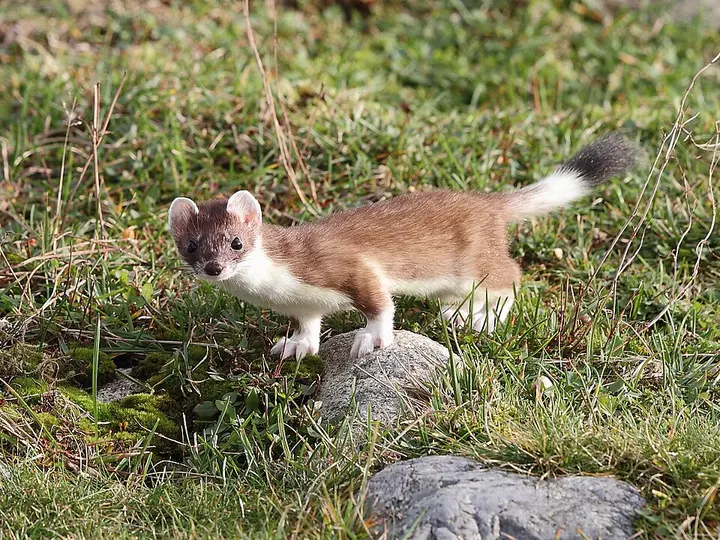
The stoat, also known as the Eurasian ermine or ermine, is a species of mustelid native to Eurasia and the northern regions of North America. Because of its wide circumpolar distribution, it is listed as Least Concern on the IUCN Red List. The name ermine is used especially in its pure white winter coat of the stoat or its fur.
Ermine fur was used in the 15th century by Catholic monarchs, who sometimes used it as the mozzetta cape. It has long been used on the ceremonial robes of members of the United Kingdom House of Lords. It was also used in capes on images such as the Infant Jesus of Prague. The stoat was introduced into New Zealand in the late 19th century to control rabbits. However, they have had a devastating effect on native bird populations; as such, the species was nominated as one of the world's top 100 "worst invaders".
Behaviour
In the Northern Hemisphere, mating occurs in the April–July period. In spring, the male's testes are enlarged, a process accompanied by an increase of testosterone concentration in the plasma. Spermatogenesis occurs in December, and the males are fertile from May to August, after which the testes regress. Female stoats are usually only in heat for a brief period, which is triggered by changes in day length. Copulation can last as long as 1 hour.
Diet
As with the least weasel, mouse-like rodents predominate in the stoat's diet. It regularly preys on larger rodent and lagomorph species, and takes individuals far larger than itself. In Russia, its prey includes rodents and lagomorphs such as European water voles, common hamsters, pikas and others, which it overpowers in their burrows. Prey species of secondary importance include small birds, fish, and shrews and, more rarely, amphibians, lizards, and insects.
Habitat
The stoat has a circumboreal range throughout North America, Europe, and Asia. The stoat in Europe is found as far south as 41ºN in Portugal, and inhabits most islands with the exception of Iceland, Svalbard, the Mediterranean islands and some small North Atlantic islands. In Japan, it is present in central mountains (northern and central Japanese Alps) to northern part of Honshu (primarily above 1,200 m) and Hokkaido.
Life cycle
In the Northern Hemisphere, mating occurs in the April–July period. In spring, the male's testes are enlarged, a process accompanied by an increase of testosterone concentration in the plasma. Spermatogenesis occurs in December, and the males are fertile from May to August, after which the testes regress. Female stoats are usually only in heat for a brief period, which is triggered by changes in day length. Copulation can last as long as 1 hour.
Where the Stoat lives
Recorded in Switzerland, France, United Kingdom, Norway, Netherlands, United States of America, Denmark, Canada, Germany, Ireland and Sweden (Europe and North America).
Most records fall in Vaud, Sankt Gallen, Bern, Puy-de-Dôme, Lucerne and Zürich.
See the Stoat’s range on the globe
Conservation status
Least concern (LC). Not at risk: it is doing well in the wild. Categories are the IUCN Red List as republished by GBIF.
Sources
The range is a density of 137,671 georeferenced GBIF records, shown on the continents where it is mainly recorded, not an expert-drawn map. Description from Wikipedia.