Animals / Bird
Steller's jay
Cyanocitta stelleri · Corvidae
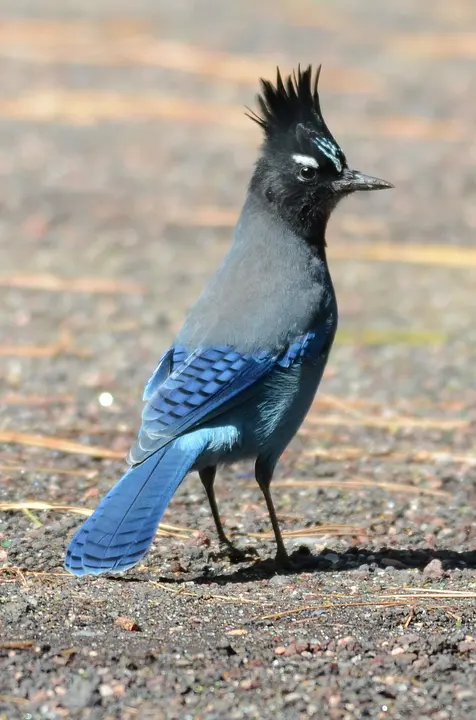
Steller's jay is a bird native to western North America and the mountains of Central America, closely related to the blue jay found in eastern North America. It is the only crested jay west of the Rocky Mountains. It is also sometimes colloquially called a "blue jay" in the Pacific Northwest, but is distinct from the blue jay of eastern North America.
The species inhabits pine-oak and coniferous forests.
Appearance
Steller's jay is about 30–34 cm (12–13 in) long and weighs about 100–140 g (3.5–4.9 oz). Steller's jay shows a great deal of regional variation throughout its range. Blackish-brown-headed birds from the north gradually become bluer-headed farther south. Steller's jay has a more slender bill and longer legs than the blue jay and, in northern populations, has a much more pronounced crest. It is also somewhat larger than the blue jay's.
Diet
Steller's jays are omnivores; their diet is about two-thirds plant matter and one-third animal matter. They gather food both from the ground and from trees. Steller's jay's diet includes a wide range of seeds, nuts, berries and other fruit. They also eat many types of invertebrates, small rodents, eggs, and nestlings such as those of the marbled murrelet. There are some accounts of them eating small reptiles, both snakes and lizards.
Life cycle
Steller's jays breed in monogamous pairs. The clutch is usually incubated entirely by the female for about 16 days. The male feeds the female during this time. Though they are known to be loud both day and night, during nesting they are quiet in order to not attract attention. The nest is usually in a conifer, but is sometimes built in a hollow in a tree or beneath the awning of a house or other structure.
Where the Steller's jay lives
Recorded in United States of America and Canada (North America).
Most records fall in California, Oregon, Washington, British Columbia, Colorado and Arizona.
See the Steller's jay’s range on the globe
Conservation status
Least concern (LC). Not at risk: it is doing well in the wild. Categories are the IUCN Red List as republished by GBIF.
Sources
The range is a density of 2,762,606 georeferenced GBIF records, shown on the continents where it is mainly recorded, not an expert-drawn map. Description from Wikipedia.