Animals / Mammal
Springhare
Pedetes capensis · Pedetidae
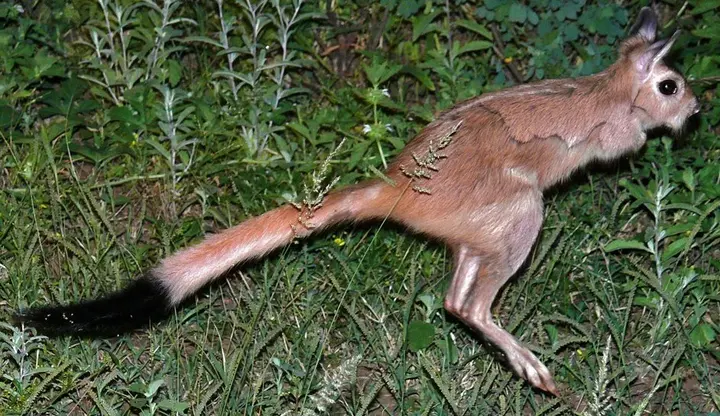
The South African springhare is a medium-sized terrestrial and burrowing rodent. Despite the name, it is not a hare. It is one of two extant species in the genus Pedetes, and is native to southern Africa.
Formerly, the genus was considered monotypic and the East African springhare (P. surdaster) was included in P. capensis. Springhares live throughout semi-arid areas in southern Africa, preferentially in sandy plains and pans with short grasses. In agricultural areas, springhares can be considered a pest due to their destructive feeding on crops. However, they are not currently considered under an impending risk of extinction.
Appearance
The springhare resembles a small kangaroo with well-developed hind legs, short front legs, and a long tail which comprises half of its body length. As well as a long tail, springhares have relatively large eyes and ears. Adults can attain 80 cm (31 in) in length (including the tail) and weigh an average of 2.5–3.5 kg (5.5–7.7 lb). Similar to kangaroos, they are also saltatorial animals who use their tails for balance.
Behaviour
Springhares are nocturnal animals, who forage during the night and retreat to a burrow during the day. While sleeping in their burrows, springhares sleep standing, with their head and forelimbs bent down in between their hindlegs, and their tail wrapped around their feet. These animals are predated upon by a variety of predators, including humans; at least 21 species prey on springhares in the Kalahari.
Life cycle
Springhares breed throughout the year and have a gestation period of about 77 days. The females give birth to a single young about three times a year. Moreover, females can be lactating and in the early stages of pregnancy at the same time.
Where the Springhare lives
Recorded in South Africa, Botswana, Namibia, Kenya and Zimbabwe (Africa).
Most records fall in Northern Cape, Kweneng, Limpopo, North-West, Central and Eastern Cape.
See the Springhare’s range on the globe
Conservation status
Least concern (LC). Not at risk: it is doing well in the wild. Categories are the IUCN Red List as republished by GBIF.
Sources
The range is a density of 854 georeferenced GBIF records, shown on the continents where it is mainly recorded, not an expert-drawn map. Description from Wikipedia.