Animals / Amphibian
Spring peeper
Pseudacris crucifer · Hylidae
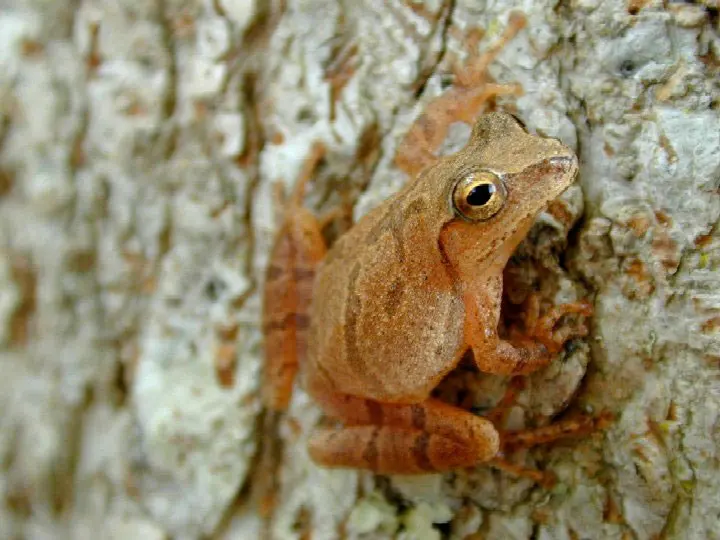
The spring peeper is a small chorus frog widespread throughout the eastern United States and eastern Canada. It prefers permanent ponds due to its advantage in avoiding predation; however, it is very adaptable with respect to the habitat it can live in. In northern regions, the frog is able to endure below freezing temperatures due to the capacity of its liver to exude and flush the bloodstream with a glucose cryoprotectant which acts both as an anti-freeze in its blood, and allows organs like the heart to enter into a state of protected dormancy.
The peeper earned its name from its chirping call, which marks the beginning of spring. Crucifer is derived from the Latin root meaning "cross-bearing", a reference to the cross-like pattern on the spring peeper's dorsal side. These chirping calls are significant for communication in mating as females choose their mates based on the frequency and volume associated with them. Satellite males who do not make any calls also strategically place themselves near those that make louder calls in an attempt to intercept females. Temperature plays a large role in when the spring peeper begins breeding as well as the duration of mating. Warm spells result in a massive increased calling rate.
Appearance
The spring peeper is a tan, grey, or brown frog with a dark cross on its dorsa (thus the Latin name crucifer, meaning cross-bearer), though sometimes the marking may be indistinct. Dark lines can also be found between the eyes and in a crossband on the hindlimbs of P. crucifer. It has a body length between less than 25 mm (0.98 in) to 38 mm (1.5 in) and a mass between 3 and 5 g (0.11 and 0.18 oz).
Diet
Tadpoles are suspension feeders, therefore they graze on inorganic and organic matter. They also feed on algae and other organisms in the water.
Life cycle
As their common name implies, the spring peeper has a high-pitched call similar to that of a young chicken, only much louder and rising slightly in tone. They are among the first frogs in the regions to call in the spring. Unlike A. americanus and P. feriarum whose call activity is dependent on seasonality, 63% of variance in P. crucifer call is explained by temperature.
Where the Spring peeper lives
Recorded in United States of America and Canada (North America).
Most records fall in Ontario, New York, Michigan, Virginia, Massachusetts and Ohio.
See the Spring peeper’s range on the globe
Conservation status
Least concern (LC). Not at risk: it is doing well in the wild. Categories are the IUCN Red List as republished by GBIF.
Sources
The range is a density of 70,969 georeferenced GBIF records, shown on the continents where it is mainly recorded, not an expert-drawn map. Description from Wikipedia.