Animals / Amphibian
Spotted salamander
Ambystoma maculatum · Ambystomatidae
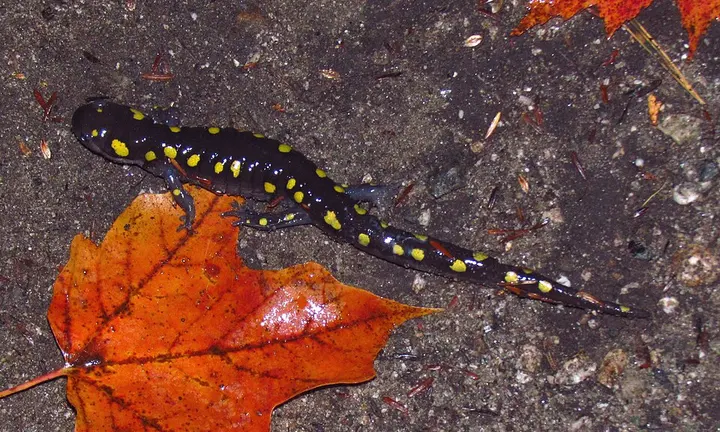
The spotted salamander, also known commonly as the yellow-spotted salamander, is a species of mole salamander in the family Ambystomatidae. The species is native to the eastern United States and Canada. It is the state amphibian of Ohio and South Carolina.
The species ranges from Nova Scotia, to Lake Superior, to southern Georgia and Texas. Its embryos have been found to have symbiotic algae, Chlorococcum amblystomatis, living in and around them, the only known example of vertebrate cells hosting an endosymbiont microbe (unless mitochondria are considered).
Appearance
The spotted salamander is about 15–25 cm (5.9–9.8 in) long (tail included), with females generally being larger than males. It is stout, like most mole salamanders, and has a wide snout. The spotted salamander's main color is black, but can sometimes be a bluish-black, dark gray, dark green, or even dark brown. Two uneven rows of yellowish-orange spots run from the top of the head (near the eyes) to the tip of the tail (dorso-lateral ranging).
Behaviour
The spotted salamander is fossorial. It rarely comes above ground, except after a rain or for foraging and breeding. During the winter, it brumates underground, and is not seen again until breeding season in early March–May. In North Amherst, Massachusetts, United States, spotted salamanders cross the street to get from their overwintering sites in the wooded area east of the roadway to their breeding sites to the west.
Diet
The spotted salamander preys upon earthworms, slugs, snails, spiders, millipedes, centipedes, insects, algae and other invertebrates. The spotted salamander larvae are aggressive predators, and have been known to cannibalize others when food is scarce. A. maculatum sometimes also eats smaller salamanders, such as the red-backed salamander. The adult spotted salamander uses its sticky tongue to catch food.
Life cycle
During the majority of the year, spotted salamanders live in the shelter of leaves or burrows in deciduous forests. However, when the temperature rises and the moisture level is high, the salamanders make their abrupt migration towards their annual breeding ponds. Recent studies, however, indicate that temperature may be a more important factor than precipitation, as precipitation in winter months increase, yet salamanders do not migrate.
Where the Spotted salamander lives
Recorded in United States of America and Canada (North America).
Most records fall in New York, Ontario, Massachusetts, Maine, Connecticut and Vermont.
See the Spotted salamander’s range on the globe
Conservation status
Least concern (LC). Not at risk: it is doing well in the wild. Categories are the IUCN Red List as republished by GBIF.
Sources
The range is a density of 41,481 georeferenced GBIF records, shown on the continents where it is mainly recorded, not an expert-drawn map. Description from Wikipedia.