Animals / Mammal
Sperm whale
Physeter macrocephalus · Physeteridae
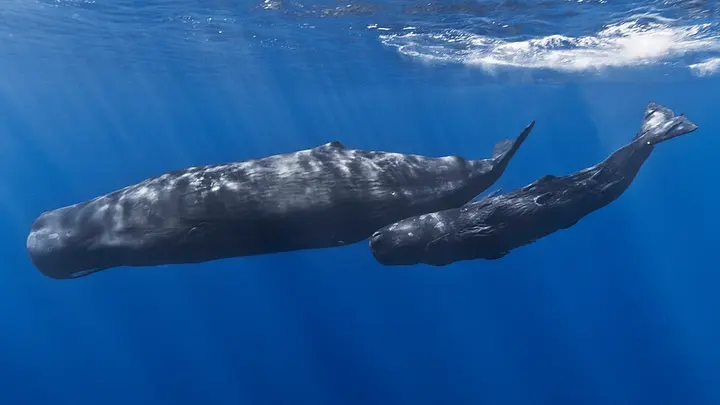
The sperm whale or cachalot is the largest of the toothed whales and the largest toothed predator. It is the only living member of the genus Physeter and one of three extant species in the sperm whale superfamily Physeteroidea, along with the pygmy sperm whale and dwarf sperm whale of the genus Kogia.
The sperm whale is a pelagic mammal with a worldwide range, and will migrate seasonally for feeding and breeding. Females and young males live together in groups, while mature males (bulls) live solitary lives outside of the mating season. The females cooperate to protect and nurse their young. Females give birth every four to twenty years and care for the calves for more than a decade. A mature, healthy sperm whale has no natural predators, although calves and weakened adults are sometimes killed by pods of orcas. Mature males average 16 metres (52 ft) in length, with the head representing up to one-third of the animal's length. Plunging to 2,250 metres (7,380 ft), it is the third deepest diving mammal, exceeded only by the southern elephant seal and Cuvier's beaked whale.
Behaviour
Sperm whales are among the most cosmopolitan species. They prefer ice-free waters over 1,000 metres (3,300 ft) deep. Although both sexes range through temperate and tropical oceans and seas, only adult males populate higher latitudes. Among several regions, such as along coastal waters of southern Australia, sperm whales have been considered to be locally extinct. They are relatively abundant from the poles to the equator and are found in all the oceans.
Diet
Sperm whales usually dive between 300 and 800 metres (980 and 2,620 ft), and sometimes 1 to 2 kilometres (3,300 to 6,600 ft), in search of food. Such dives can last more than an hour. They feed on several species, notably the giant squid, but also the colossal squid, octopuses, and fish such as demersal rays and sharks, but their diet is mainly medium-sized squid. Sperm whales may also possibly prey upon swordfish on rare occasions.
Habitat
Sperm whales are among the most cosmopolitan species. They prefer ice-free waters over 1,000 metres (3,300 ft) deep. Although both sexes range through temperate and tropical oceans and seas, only adult males populate higher latitudes. Among several regions, such as along coastal waters of southern Australia, sperm whales have been considered to be locally extinct. They are relatively abundant from the poles to the equator and are found in all the oceans.
Life cycle
Sperm whales can live 70 years or more. The oldest recorded living sperm whale was 77–80 years old. According to data on cetacean hunting collected in South Africa, the ages of the older individuals among the 22 surveyed were estimated to be between 42 and 61 years.
Where the Sperm whale lives
Recorded in Portugal, United States of America, Fr. S. Antarctic Lands, France, Chile, Canada, Spain, Ashmore and Cartier Is. and New Zealand (Europe, North America, Seven seas (open ocean), South America and Oceania).
Most records fall in Azores, Guadeloupe, Madeira, Baleares, Canterbury and Oregon.
See the Sperm whale’s range on the globe
Conservation status
Vulnerable (VU). At risk: it could become endangered. Categories are the IUCN Red List as republished by GBIF.
Sources
The range is a density of 107,229 georeferenced GBIF records, shown on the continents where it is mainly recorded, not an expert-drawn map. Description from Wikipedia.