Animals / Bird
Sparkling violetear
Colibri coruscans · Trochilidae
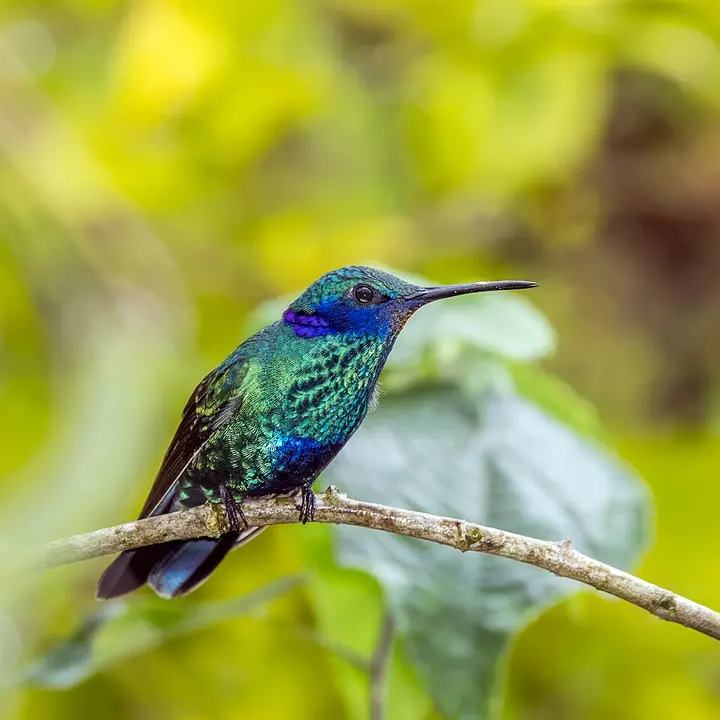
The sparkling violetear is a species of hummingbird widespread in highlands of northern and western South America, including a large part of the Andes, the Venezuelan Coastal Range, and the Tepuis. It occurs in a wide range of semi-open habitats, even in gardens and parks within major cities such as Quito, and is often the most common species of hummingbird in its range. It is highly vocal and territorial.
Appearance
The sparkling violetear is the largest violetear at 13 to 14 cm (5 to 5.5 in) long. Male birds weigh 5.8 to 8.5 g (0.20 to 0.30 oz) and females 6 to 7.5 g (0.21 to 0.26 oz). The nominate male's upperparts are metallic bluish green, the chin bluish violet, the belly blue, and the rest of the underparts green. Long erectile bluish violet plumes cover the ears. The tail is metallic green with a steely blue band near the end.
Behaviour
The páramo populations of sparking violear move to as low as 2,000 m (6,600 ft) in the dry season. Populations below the páramo are generally year-round residents though they may make short movements.
Diet
The sparkling violetear forages for nectar from a wide variety of flowering plants at all levels of the forest from the ground to the canopy. It also captures insects on the wing. It is very aggressive in most habitats, dominating all other hummingbirds while defending flowering trees, but aggression has not been observed in the páramo.
Habitat
The nominate subspecies of sparkling violetear is widely distributed. It is found in Venezuela's Sierra de Perijá, Colombia's Sierra Nevada de Santa Marta, and the Andes from Venezuela through Colombia, Ecuador, Peru, and Bolivia into northern Chile and northwestern Argentina. C. c. germanus is found on the tepuis of southern Venezuela, western Guyana, and the adjacent Brazilian state of Roraima.
Life cycle
The sparkling violetear's breeding seasons vary across its range, from July through October in Venezuela to December through February in Argentina. The nest is a cup made of soft plant materials and decorated with lichens on its outside. It is placed on a horizontal branch, attached to a drooping twig, or sometimes in a cleft in rocks. The clutch size is two eggs. The incubation time is 17 to 18 days with fledging 20 to 22 days after hatch.
Where the Sparkling violetear lives
Recorded in Colombia, Ecuador, Peru, Venezuela and Bolivia (South America).
Most records fall in Bogota, Pichincha, Cundinamarca, Cusco, Caldas and Tungurahua.
See the Sparkling violetear’s range on the globe
Conservation status
Least concern (LC). Not at risk: it is doing well in the wild. Categories are the IUCN Red List as republished by GBIF.
Sources
The range is a density of 239,316 georeferenced GBIF records, shown on the continents where it is mainly recorded, not an expert-drawn map. Description from Wikipedia.