Animals / Mammal
Southern elephant seal
Mirounga leonina · Phocidae
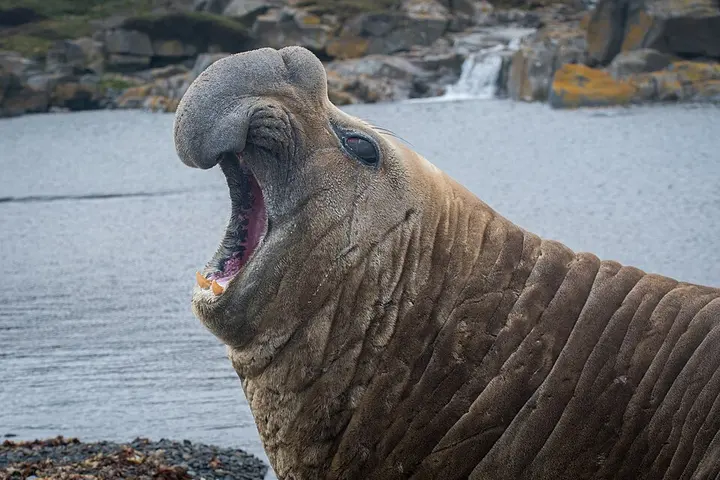
The southern elephant seal is one of two species of elephant seals. It is the largest member of the clade Pinnipedia and the order Carnivora, as well as the largest extant marine mammal that is not a cetacean. It gets its name from its massive size and the large proboscis of the adult male, which is used to produce very loud roars, especially during the breeding season.
A bull southern elephant seal is about more than twice the weight of a male northern elephant seal (Mirounga angustirostris) as large sub-adult southern elephant seals have weighed 3 tons, as well as more than twice the weight of a male Pacific walrus (Odobenus rosmarus divergens).
Appearance
The southern elephant seal is distinguished from the northern elephant seal (which does not overlap in range with this species) by its greater body mass and a shorter proboscis. The southern males also appear taller when fighting, due to their tendency to bend their backs more strongly than the northern species. This species may also exhibit the greatest sexual dimorphism of any mammal in terms of mass ratio, with males typically four to five times heavier than females.
Behaviour
Elephant seals are among the seals that can stay on land for the longest periods of time, as they can stay dry for several consecutive weeks each year. Males arrive in the colonies earlier than the females and fight for control of harems when they arrive. Large body size confers advantages in fighting, and the agonistic relationships of the bulls gives rise to a dominance hierarchy, with access to harems and activity within harems being determined by rank.
Where the Southern elephant seal lives
Recorded in Antarctica, Ashmore and Cartier Is., Fr. S. Antarctic Lands, S. Geo. and the Is., South Africa and Heard I. and McDonald Is. (Antarctica, Oceania, Seven seas (open ocean) and Africa).
Most records fall in Macquarie Island, Western Cape and Archipel des Kerguelen.
See the Southern elephant seal’s range on the globe
Conservation status
Vulnerable (VU). At risk: it could become endangered. Categories are the IUCN Red List as republished by GBIF.
Sources
The range is a density of 1,095,609 georeferenced GBIF records, shown on the continents where it is mainly recorded, not an expert-drawn map. Description from Wikipedia.