Animals / Bird
Southern cassowary
Casuarius casuarius · Casuariidae
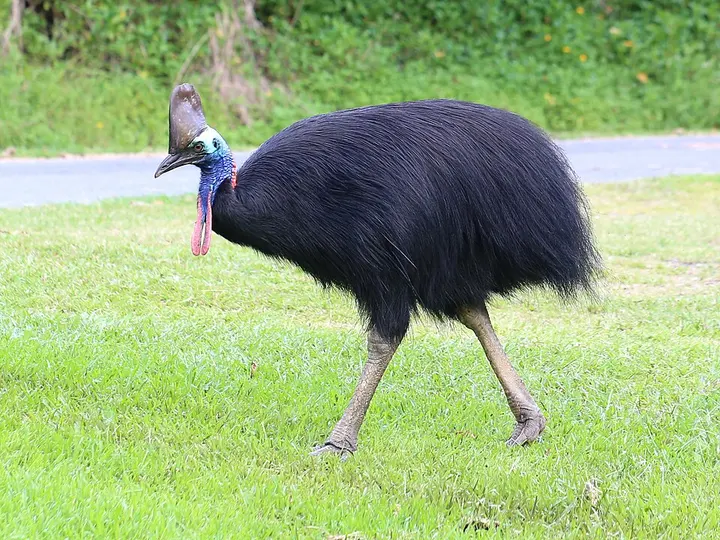
The southern cassowary, also known as double-wattled cassowary, Australian cassowary, or two-wattled cassowary, is a large, flightless, mostly black bird, found in Indonesia, Papua New Guinea, and northeastern Australia. It is one of the three living species of cassowary, alongside the dwarf cassowary and the northern cassowary. It is a ratite and therefore related to the emu, ostrich, rhea and kiwi.
Southern cassowaries are among the largest birds in the world, only weighing less than ostriches. The Australian population is listed as Endangered under federal and Queensland state legislation.
Appearance
The adult southern cassowary has stiff, bristly black plumage, a blue face and a long neck, red on the cape and two red wattles measuring up to 18 cm (7.1 in) in length hanging down around its throat. A horn-like brown casque, measuring 13 to 20 cm (5.1 to 7.9 in) high, sits atop the head. The bill can range from 9.8 to 19 cm (3.9 to 7.5 in).
Behaviour
Southern cassowaries make a thunderous call during mating season, and hissing and rumblings otherwise. Chicks will make frequent high-pitched contact whistles and chirps to call the male.
Diet
Southern cassowaries forage on the forest floor for fallen fruit and seeds and are capable of safely digesting some fruits and seeds toxic to other animals. They also eat fungi, and some insects, other invertebrates (such as snails), small vertebrates (such as fish, frogs, small birds and their eggs and nestlings, and small mammals), and carrion. When food is scarce, both wild and captive cassowaries have been seen to ingest earth, perhaps seeking supplementary minerals.
Life cycle
The southern cassowary is a solitary bird, which pairs only in breeding season, in late winter or spring (but highly variable). The male builds a nest on the ground, a mattress of herbaceous plant material 5 to 10 centimetres (2–4 in) thick and up to 100 centimetres (39 in) wide. This is thick enough to let moisture drain away from the eggs. The male also incubates the eggs and raises the chicks alone.
Where the Southern cassowary lives
Recorded in Ashmore and Cartier Is. (Oceania).
Most records fall in Queensland.
See the Southern cassowary’s range on the globe
Conservation status
Least concern (LC). Not at risk: it is doing well in the wild. Categories are the IUCN Red List as republished by GBIF.
Sources
The range is a density of 10,130 georeferenced GBIF records, shown on the continents where it is mainly recorded, not an expert-drawn map. Description from Wikipedia.