Animals / Mammal
South American tapir
Tapirus terrestris · Tapiridae
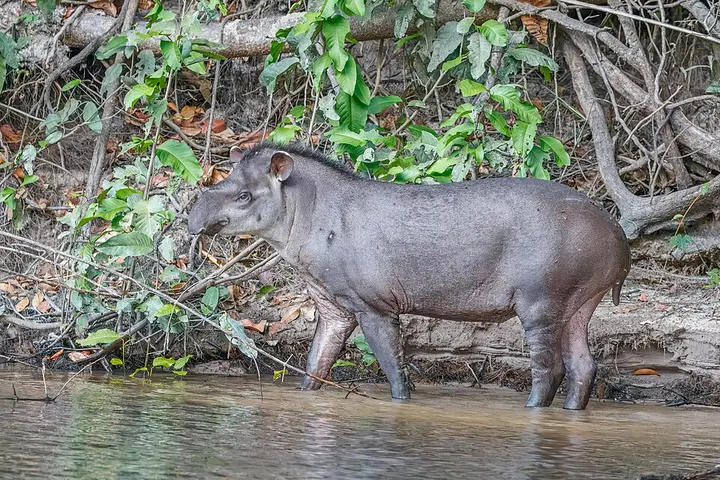
The South American tapir, also commonly called the Brazilian tapir, the Amazonian tapir, the maned tapir, the lowland tapir, anta, and sachavaca, is one of the four recognized species in the tapir family. It is the largest surviving native terrestrial mammal in the Amazon.
Most classifications also include Tapirus kabomani (also known as the dwarf black tapir or the kabomani tapir) as also belonging to the species Tapirus terrestris (Brazilian tapir), despite its questionable existence and the overall lack of information on its habits and distribution. The specific epithet derives from arabo kabomani, the word for tapir in the local Paumarí language. The formal description of this tapir did not suggest a common name for the species. The Karitiana people call it the little black tapir. It is, purportedly, the smallest tapir species, even smaller than the mountain tapir (T. pinchaque), which had been considered the smallest.
Appearance
T. terrestris is dark brown, paler in the face, and has a low, erect crest running from the crown down the back of the neck. The round, dark ears have distinctive white edges. Newborn tapirs have a dark brown coat, with small white spots and stripes along the body. The South American tapir can attain a body length of 1.8 to 2.5 m (5 ft 11 in to 8 ft 2 in) with a 5 to 10 cm (2.0 to 3.9 in) short stubby tail and an average weight around 225 kg (496 lb).
Behaviour
T. terrestris is an excellent swimmer and diver, but also moves quickly on land, even over rugged, mountainous terrain. It has a life span of approximately 25 to 30 years.
Diet
The South American tapir is an herbivore. Using its mobile nose, it feeds on leaves, buds, shoots, and small branches it tears from trees, fruit, grasses, and aquatic plants. They also feed on the vast majority of seeds found in the rainforest. This is known because the diet is studied through observation of browsing, analysis of feces, and studying stomach contents.
Habitat
The South American tapir can be found near water in the Amazon rainforest and River Basin in South America, east of the Andes. Its geographic range stretches from Venezuela, Colombia, and the Guianas in the north to Brazil, Argentina, and Paraguay in the south, to Bolivia, Peru, and Ecuador in the west. On rare occasions, waifs have crossed the narrow sea channel from Venezuela to the southern coast of the island of Trinidad (but no breeding population exists there).
Life cycle
T. terrestris mates in April, May, or June, reaching sexual maturity in the third year of life. Females go through a gestation period of 13 months (390–395 days) and will typically have one offspring every two years. A newborn South American tapir weighs about 15 pounds (6.8 kilos) and will be weaned in about six months.
Where the South American tapir lives
Recorded in Colombia, Brazil, Argentina and Ecuador (South America).
Most records fall in Meta, Misiones, Mato Grosso do Sul, Amazonas, Vichada and Orellana.
See the South American tapir’s range on the globe
Conservation status
Vulnerable (VU). At risk: it could become endangered. Categories are the IUCN Red List as republished by GBIF.
Sources
The range is a density of 21,930 georeferenced GBIF records, shown on the continents where it is mainly recorded, not an expert-drawn map. Description from Wikipedia.