Animals / Mammal
South American coati
Nasua nasua · Procyonidae
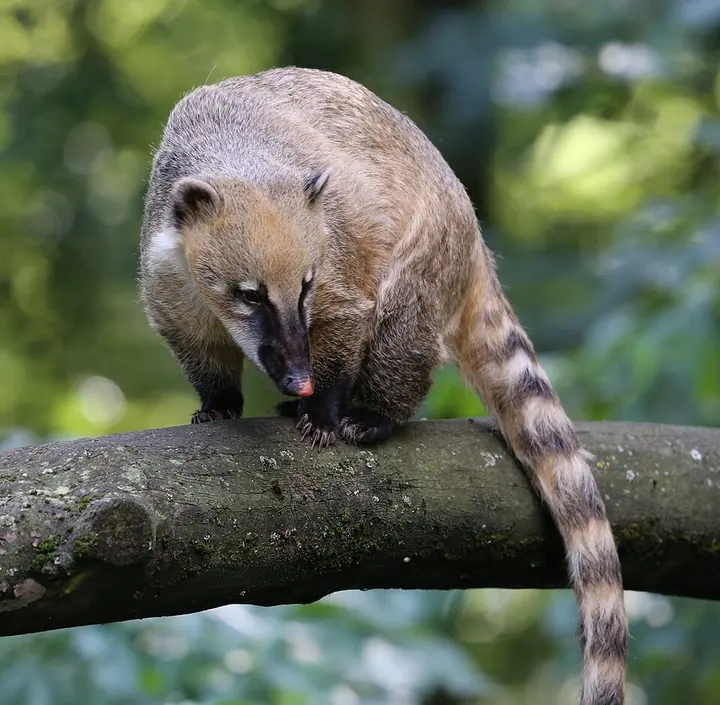
The South American coati, also known as the ring-tailed coati or brown-nosed coati, is a coati species and a member of the raccoon family (Procyonidae), found in the tropical and subtropical parts of South America. An adult generally weighs from 2–7.2 kg (4.4–15.9 lb) and is 85–113 cm (33–44 in) long, with half of that being its tail. Its color is highly variable and the rings on the tail may be only somewhat visible, but its most distinguishing characteristic is that it lacks the largely white snout of its northern relative, the white-nosed coati.
Behaviour
The South American coati is diurnal and lives both on the ground and in trees. It is omnivorous but primarily eats fruit, invertebrates, other small animals, and bird eggs. It also searches for fruit in trees high in the canopy and uses its snouts to poke through crevices to find animal prey on the ground. Furthermore, it also searches for animal prey by turning over rocks on the ground or ripping open logs with its claws.
Habitat
The South American coati is widespread in tropical and subtropical South America. It occurs in the lowland forests east of the Andes as high as 2,500 m (8,200 ft) from Colombia and The Guianas south to Uruguay and northern Argentina. Nasua nasua occupancy is significantly and negatively related to elevation but positively related to forest cover. It has been recorded in west Ecuador, and north and west Colombia.
Life cycle
All females in a group come into heat simultaneously when fruit is in season and mate with several males. The gestation period is 74 to 77 days. The estrus period lasts 1–2 weeks. Captive females give birth to 1–7 young at a time. In the wild, they leave the group to give birth in a nest built in trees and rejoin the group with their offspring 5–6 weeks later. They usually remain with their natal group.
Where the South American coati lives
Recorded in Brazil, Colombia, Argentina, Ecuador and Chile (South America).
Most records fall in Paraná, Meta, Misiones, São Paulo, Rio de Janeiro and Santander.
See the South American coati’s range on the globe
Conservation status
Least concern (LC). Not at risk: it is doing well in the wild. Categories are the IUCN Red List as republished by GBIF.
Sources
The range is a density of 12,255 georeferenced GBIF records, shown on the continents where it is mainly recorded, not an expert-drawn map. Description from Wikipedia.