Animals / Bird
Somali ostrich
Struthio molybdophanes · Struthionidae
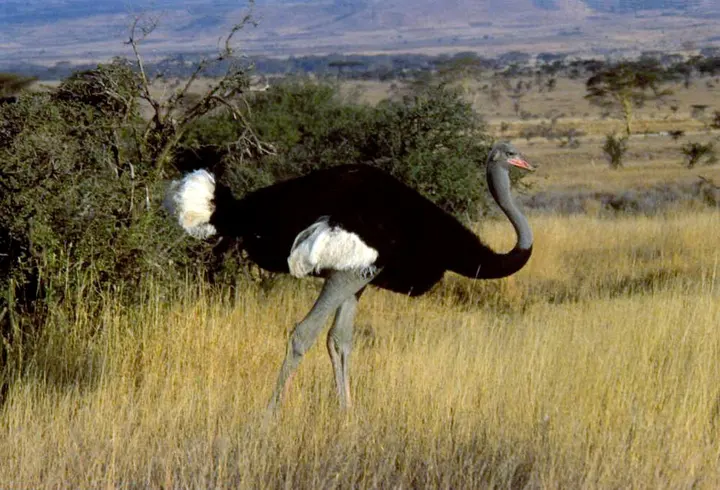
The Somali ostrich, also known as the blue-necked ostrich, is a large flightless bird native to the Horn of Africa. It is one of two living species of ostriches, the other being the common ostrich. It was also previously considered a subspecies of the common ostrich, but was identified as a distinct species in 2014.
For a long time, Somalis partially domesticated some of these ostriches.
Appearance
Though generally similar to other ostriches, the skin of the neck and thighs of the Somali ostrich is blue-tinged grey (rather than pinkish), becoming brighter blue on the male during the mating season. The neck lacks any broad white ring. The wing primary and tail feathers are white in males, and brown in females. The males are larger than the females.
Behaviour
The Somali ostrich is differentiated ecologically from the common ostrich, with which there is some range overlap, by preferring bushier, more thickly vegetated areas, where it feeds largely by browsing, whereas the common ostrich is mainly a grazer on open savanna. There are also reports of interbreeding difficulties between the two taxa.
Habitat
The Somali ostrich is mostly found in the Horn of Africa, especially in north-eastern Ethiopia, southern Djibouti, most of Kenya, and across most of Somalia.
Where the Somali ostrich lives
Recorded in Kenya and Ethiopia (Africa).
Most records fall in Eastern, Rift Valley, Coast, Oromiya, Afar and North-Eastern.
See the Somali ostrich’s range on the globe
Conservation status
Vulnerable (VU). At risk: it could become endangered. Categories are the IUCN Red List as republished by GBIF.
Sources
The range is a density of 5,089 georeferenced GBIF records, shown on the continents where it is mainly recorded, not an expert-drawn map. Description from Wikipedia.