Animals / Bird
Snowy owl
Bubo scandiacus · Strigidae
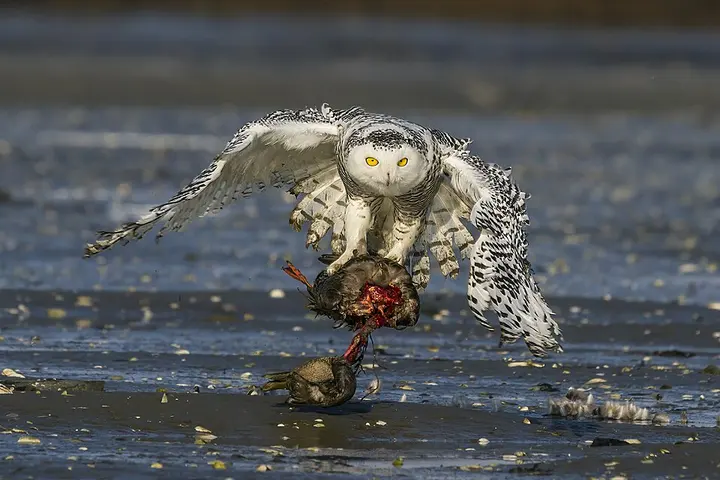
The snowy owl, also known as the polar owl, the white owl and the Arctic owl, is a large, white owl of the true owl family. Snowy owls are native to the Arctic regions of both North America and the Palearctic, breeding mostly on the tundra. It has a number of unique adaptations to its habitat and lifestyle, which are quite distinct from other extant owls.
One of the largest species of owl, it is the only owl with mainly white plumage. Males tend to be a purer white overall while females tend to have more extensive flecks of dark brown. Juvenile male snowy owls have dark markings and may appear similar to females until maturity, at which point they typically turn whiter. The composition of brown markings about the wing, although not foolproof, is the most reliable technique for aging and sexing individual snowy owls. Most owls sleep during the day and hunt at night, but the snowy owl is often active during the day, especially in the summertime. The snowy owl is both a specialized and generalist hunter.
Appearance
The snowy owl is mostly white. They are purer white than predatory mammals such as polar bears (Ursus maritimus) and Arctic fox (Vulpes lagopus). Often when seen in the field, these owls can resemble a pale rock or a lump of snow on the ground. They usually appear to lack ear tufts but very short (and probably vestigial) tufts can be erected in some situations, perhaps most frequently by the female when she is sitting on the nest.
Behaviour
The snowy owl differ in their calls from other Bubo owls, with a much more barking quality to their version of a hooting song. Perhaps as many as 15 different calls by mature snowy owls have been documented. The main vocalization is a monotonous sequence that normally contains 2–6 (but occasionally more), rough notes similar to the rhythm of a barking dog: krooh krooh krooh krooh...
Diet
Snowy owls may hunt at nearly any time of the day or night, but may not attempt to do so during particularly severe weather. During the summer solstice, the owls appear to hunt during "theoretical nightfall". Night-vision devices have allowed biologists to observe that snowy owls hunt quite often during the extended nighttime during the northern winter. Prey are both taken and eaten on the ground. Like other carnivorous birds, Snowy owls often swallow their small prey whole.
Habitat
The snowy owl is typically found in the northern circumpolar region, where it makes its summer home north of latitude 60° north though sometimes down to 55 degrees north. However, it is a particularly nomadic bird, and because population fluctuations in its prey species can force it to relocate, it has been known to breed at more southerly latitudes.
Where the Snowy owl lives
Recorded in United States of America and Canada (North America).
Most records fall in Québec, Ontario, Michigan, Massachusetts, New York and Wisconsin.
See the Snowy owl’s range on the globe
Conservation status
Vulnerable (VU). At risk: it could become endangered. Categories are the IUCN Red List as republished by GBIF.
Sources
The range is a density of 299,204 georeferenced GBIF records, shown on the continents where it is mainly recorded, not an expert-drawn map. Description from Wikipedia.