Animals / Bird
Snowy albatross
Diomedea exulans · Diomedeidae
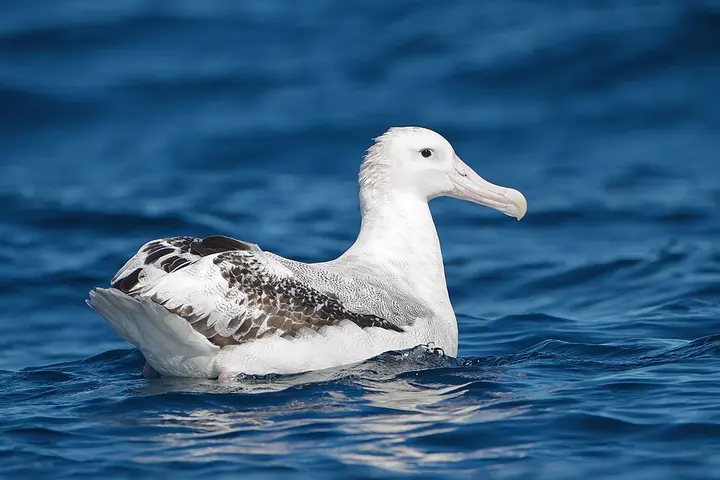
The snowy albatross, also known as the wandering albatross, white-winged albatross, or goonie, is a large seabird from the family Diomedeidae; they have a circumpolar range in the Southern Ocean. It is the largest species of albatross and was long considered to be the same species as the Tristan albatross and the Antipodean albatross. Together with the Amsterdam albatross, it forms the wandering albatross species complex, which some began referring to more recently as "snowy".
The snowy albatross is one of the two largest members of the genus Diomedea (the great albatrosses), being similar in size to the southern royal albatross. It has the greatest known wingspan of any living bird and is also one of the most far-ranging birds. Some individual snowy albatrosses are known to circumnavigate the Southern Ocean three times in one year, covering more than 120,000 km (75,000 mi).
Appearance
The plumage varies with age, with the juveniles starting chocolate brown. As they age they become whiter. The adults have white bodies with white and black wings. Males have whiter wings than females, with just the tips and trailing edges of the wings black. The snowy albatross is the whitest of the wandering albatross species complex, the other species having a great deal more brown and black on the wings and body, very closely resembling immature wandering albatrosses.
Behaviour
Snowy albatrosses travel vast distances to find food, and tend to feed further out in open oceans and in colder waters further south, whereas other albatross such as the related royal albatross tend to forage in somewhat shallower waters and closer to continental shelves. They feed at the surface, mainly during daylight hours, and are not well adapted for diving. During flight, speeds of 135 km/h (84 mph) have been recorded.
Diet
Snowy albatrosses travel vast distances to find food, and tend to feed further out in open oceans and in colder waters further south, whereas other albatross such as the related royal albatross tend to forage in somewhat shallower waters and closer to continental shelves. They feed at the surface, mainly during daylight hours, and are not well adapted for diving. During flight, speeds of 135 km/h (84 mph) have been recorded.
Habitat
The snowy albatross breeds on South Georgia Island, Crozet Islands, Kerguelen Islands, Prince Edward Islands, and Macquarie Island, is seen feeding year-round off the Kaikōura Peninsula on the east coast of the South Island of New Zealand, and ranges in all the southern oceans from 28° to 60°. Some individual snowy albatrosses are known to circumnavigate the Southern Ocean three times, covering more than 120,000 km (75,000 mi), in one year.
Where the Snowy albatross lives
Recorded in Ashmore and Cartier Is., S. Geo. and the Is., South Africa, New Zealand, Fr. S. Antarctic Lands, Chile, Antarctica, Falkland Is., Heard I. and McDonald Is. and Argentina (Oceania, Seven seas (open ocean), Africa, South America and Antarctica).
Most records fall in New South Wales, Western Cape, Tasmania, Macquarie Island, Victoria and Aisén del General Carlos Ibáñez del Campo.
See the Snowy albatross’s range on the globe
Conservation status
Vulnerable (VU). At risk: it could become endangered. Categories are the IUCN Red List as republished by GBIF.
Sources
The range is a density of 158,974 georeferenced GBIF records, shown on the continents where it is mainly recorded, not an expert-drawn map. Description from Wikipedia.